
First Timer’s Guide to Agile Mobile Development: Exploring the different phases of mobile app development
Learn moreSwipe to Check More
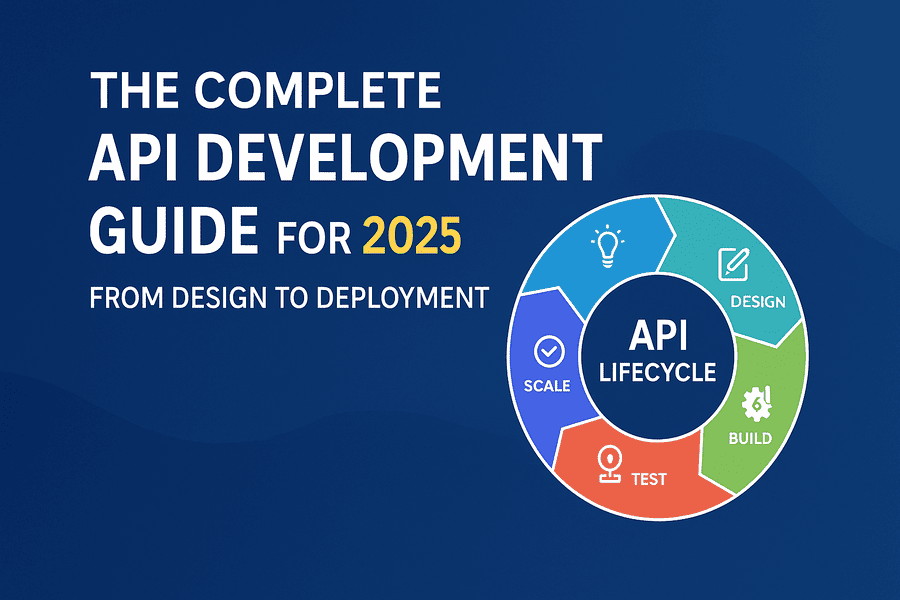

In the digital-first era of 2025, Application Programming Interfaces (APIs) have moved from being simple connectors to becoming the engine of innovation. APIs enable apps, platforms, and businesses to exchange data, integrate systems, and deliver seamless user experiences. Whether you are an enterprise looking to automate workflows, a startup entering the Mobile App Development Company landscape, or a business innovating with AI App Development, APIs play a central role.
According to a 2025 Gartner report, more than 80% of enterprises rely on APIs for at least one critical function. APIs are no longer a “nice-to-have”; they are mission-critical assets.
This guide will take you through the complete journey of API development — from planning and building to testing, deploying, and scaling like a pro. Along the way, we’ll explore tools, frameworks, best practices, costs, and future trends shaping API development in 2025.
API development refers to the process of designing, building, and deploying APIs that enable communication between two or more software applications. Simply put, APIs act as messengers — they deliver requests from one system and return responses from another.
Examples in everyday life:
In 2025, API development is more strategic than ever. Businesses rely on APIs for:
| API Type | Description | Example Use Cases |
|---|---|---|
| Open APIs | Publicly available for developers. | Google Maps API, Twitter API |
| Internal APIs | Used only within organizations. | HR, payroll, or finance APIs |
| Partner APIs | Shared with selected partners for collaboration. | Payment gateway APIs (Stripe, Razorpay) |
| Composite APIs | Combine multiple requests/responses into a single call. | Travel apps (Flights + Hotels + Car Rentals) |
| AI APIs | Enable machine learning and artificial intelligence capabilities. | OpenAI API, AWS Rekognition |
| IoT APIs | Connect smart devices and IoT ecosystems. | Smart home apps, connected cars |
| Blockchain APIs | Enable decentralized apps and secure transactions. | Ethereum, Ripple APIs |
Choosing the right architecture is a critical step in API development:
| Category | Tools |
|---|---|
| Design & Docs | Swagger, Postman, Insomnia |
| Backend Dev | Node.js (Express), Django REST, Spring Boot, Flask, .NET Core |
| Testing | Postman, JMeter, SoapUI, Newman |
| Security | OAuth 2.0, JWT, API Gateway |
| Deployment | AWS API Gateway, Kong, Apigee, Azure API Management |
| Monitoring | Datadog, Grafana, Prometheus, New Relic |
Security breaches cost businesses billions. APIs are often targeted due to misconfigurations.
Security Measures
API development costs vary based on complexity, features, and geography.
| API Complexity | Cost (India) | Cost (USA/Europe) |
|---|---|---|
| Simple (1–2 APIs) | $2,000 – $5,000 | $5,000 – $12,000 |
| Medium (10–15 APIs) | $10,000 – $25,000 | $25,000 – $60,000 |
| Complex (50+ APIs) | $50,000+ | $100,000+ |
? Businesses often reduce cost by partnering with offshore teams or a Mobile App Development Company offering end-to-end solutions.
By 2030, APIs will be smarter, faster, and more integrated. Key trends:
The future of digital business belongs to those who master APIs.
API development in 2025 is no longer optional — it is a strategic necessity. Businesses that embrace APIs can unlock scalability, enhance security, and innovate faster.
From planning and building to testing and deploying, this guide has shown you how to develop APIs like a pro. Whether you are innovating in fintech, ecommerce, or AI App Development, APIs will drive your success.
API development is the process of creating software interfaces (APIs) that allow two applications to communicate. For example, when a food delivery app shows you a live map, it’s using Google Maps API in the backend.
The timeline depends on complexity.
A simple API can take 1–2 weeks.
Medium-sized APIs (10–15 endpoints) may take 1–2 months.
Large enterprise APIs can take 3–6 months or more.
On average:
Simple API: $2,000 – $5,000 in India.
Medium complexity: $10,000 – $25,000.
Large enterprise-level APIs: $50,000+.
Costs are higher in the US/Europe. Partnering with a Mobile App Development Company often reduces costs.
Popular stacks include:
Node.js (Express)
Python (Django REST/Flask)
Java (Spring Boot)
.NET Core
For API design: Swagger/OpenAPI and Postman are industry standards.
Best practices include:
Use OAuth 2.0 and JWT tokens.
Enforce rate limiting.
Encrypt data with TLS/SSL.
Deploy through an API Gateway (AWS, Kong, Apigee).
AI-powered APIs for automation and data processing.
Blockchain APIs for secure transactions.
No-code/low-code APIs for faster adoption.
IoT APIs for smart devices and connected ecosystems.
Yes. Many startups begin with basic APIs or MVPs and expand as they grow. Offshore development or hiring a Mobile App Development Company often makes it cost-effective.