


On Demand App Development Company in India
Develop your on-demand app with a product strategy designed around your customers, service providers, operations, and your business's long-term goals.
People no longer want to make a dozen calls to book a cab, find a meal, or schedule a service. They no longer want to wait for people to show up. They want to book everything with one tap.
Getting a cab, meal, plumber, doctor, or parcel delivered is now as simple as tapping a button, making a booking, tracking it, and then being done with it. People don't want to wait anymore. If you want to create a product similar to this, you need more than a mobile app. You need a real time platform which helps your customers, service providers, and your admin team work together without friction. The best on demand app development companies builds this for you.
At Corewave, we design and develop real time, end to end custom on demand apps for startups, businesses and enterprises in India. This page answers the cost, timeline, how these apps make money, and how to identify the right partner. We do not use jargon and make no unrealistic promises.
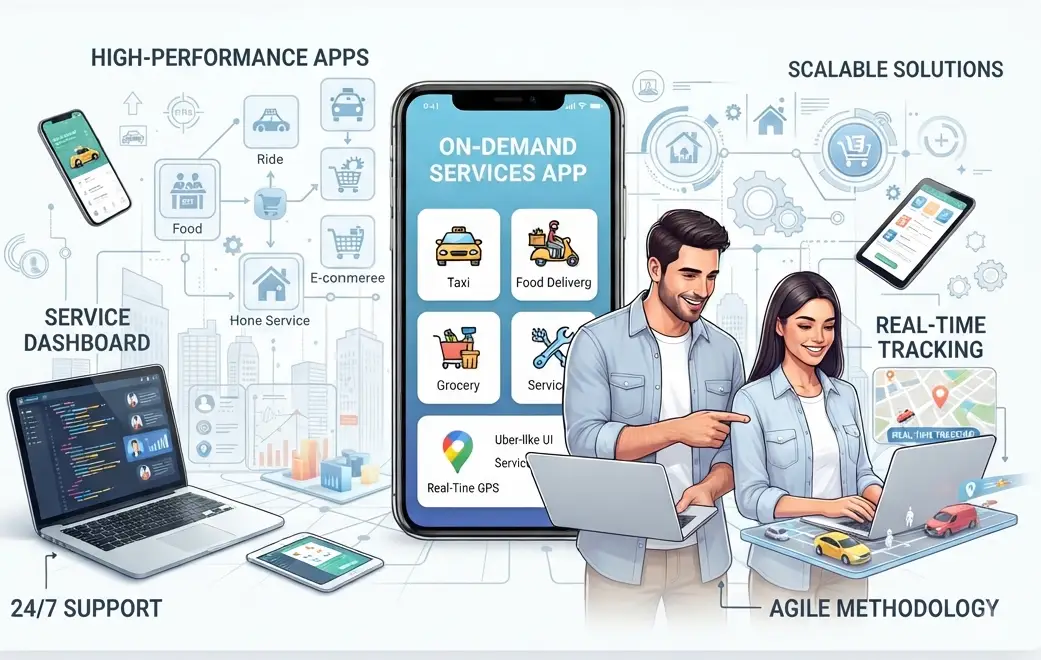



Corewave is an on-demand app development company in India that builds custom apps for taxi booking, food and grocery delivery, home services, healthcare, courier and logistics, beauty, education and multi-service super apps. Our end to end on demand app development services include the customer app, service provider app, and admin panel, with features like real time tracking, UPI and card payments, and AI based recommendation. It takes us about 8 to 12 weeks to develop an MVP and 4 to 6 months to develop a fully featured on demand platform.
What Is On Demand App Development?
On-demand app development is creating applications that facilitate quick service and/or delivery. Popular uses of on-demand apps include making a ride reservation, ordering a meal, calling an electrician, and consulting a doctor over a video call.
The word "demand" is important. The customer decides when and where. The platform provides the means and logistics to connect them with the nearest available service provider.
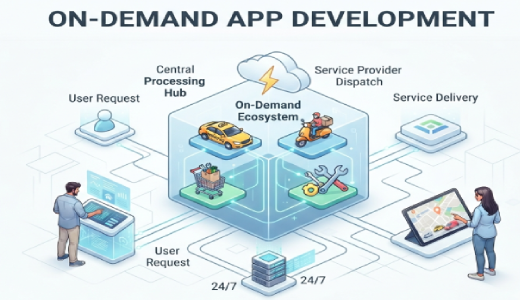
How an on-demand app works
There are three main components of every on-demand app, regardless of the industry:
The customer app.
The customer searches and makes the booking. The customer may also pay through the app and/or track the status of the service/product.
The service provider app.
The service provider accepts a job, navigates to the service, and gets paid.
The admin dashboard.
The business owner configures user types and access, determines prices and commissions, resolves disputes, and generates business reports.
For example, in a taxi app, the customer app allows a customer to search for and request a taxi, pay for the ride, and track the taxi. The customer app also displays the estimated time of arrival of the taxi. The taxi driver app accepts a ride request, navigates to the pick-up location, and transports the customer to the drop-off location. The taxi driver app also displays the route and destination of the customer. The admin dashboard allows the business owner to determine the price for each route, review disputes, and access reports on the status of the business.
These three apps serve as the front end to a power backend which processes payments, does matching and creates notifications. It also does live location. The more these pieces communicate, the more seamless the user experience. Most on demand apps fail not because of the idea itself, but because of failed provider supply, payments or tracking at the wrong moment.
The on demand market in India
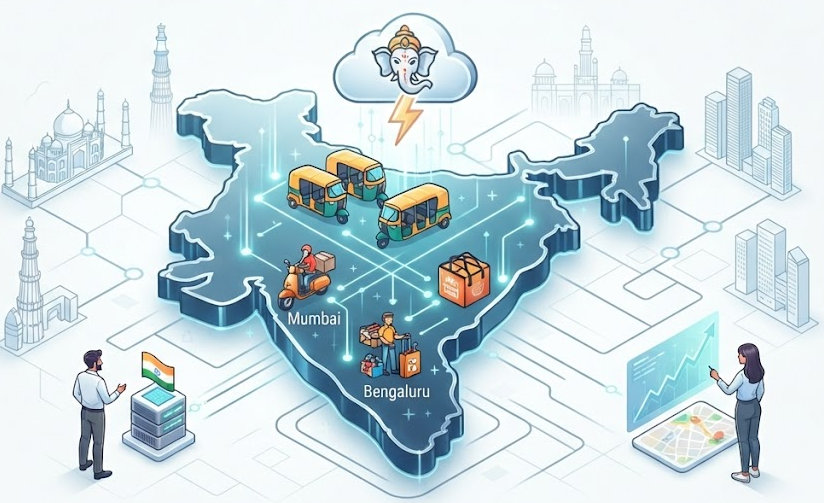
The Indian market has matured for use cases of on demand services. The combination of the accessibility of smart devices, UPI's electronic payments and the growing urbanization means consumers in smaller cities and towns have become accustomed to the same level of convenience as those in bigger cities.
The Covid-19 pandemic led to exponential growth in the use of on demand services and businesses focused around delivering goods and services to consumers in the quickest possible manner. The "new normal" gave rise to the growth of teleconsultation and other on demand services, making a strong case for new entrants focused on specific communities, goods and services.
Our On-Demand App Development Services
Different on-demand businesses have different types of customers, workflows, service providers, operational needs, and business models. Our development strategy thus focuses on understanding how your business works and creating digital solutions to address those business requirements.
Types of On-Demand Apps We Develop
In the on-demand economy, users require immediate access to a service or product. There are thousands of businesses that can adopt this model. Some existing examples include Food and Grocery Delivery, Home Services and Healthcare. There is also rising demand for Transportation, Delivery, and (Ride) Hailing services.
On-Demand Taxi and Ride-Hailing Apps
Passengers and drivers are connected by these applications based on their location, availability, and type of vehicle.
A couple of key features of such applications are booking a ride, connecting passengers with drivers, and integrating real-time GPS along with navigation. Other features can include digital payment systems, fare calculation, and ride scheduling. Customers can also provide ratings and feedback. Notifications and ride history are also added features. Drivers can also track their earnings for a specific time period.
On-Demand Food Delivery Apps
These applications allow customers to place orders and pay online. Customers can also track their orders and get them delivered.
A complete solution includes restaurant management and discovery systems, cart and menu management, online order placement, payment processing, and order and delivery tracking. Features can also include notifications and offers.
On-Demand Grocery Delivery Apps
These applications help manage product and service availability based on location.
Grocery delivery applications can be developed to manage multiple stores and provide services for a specific area.
On-Demand Home Services Apps
These applications connect customers with professionals for various services.
Customers can also book appointments and make payments online. Customers can also communicate with service professionals and provide feedback.
On-Demand Healthcare Apps
These applications also allow customers to book appointments online.
Other features of such applications can include online health consultations and other health and wellness services.
Apart from the features mentioned above, healthcare applications require additional security and privacy features.
On-Demand Doctor Consultation Apps
Users can search for a healthcare professional using the online doctor consultation platform, check the professional's availability, book an appointment and manage consultations.
Depending on the business requirements, the platform can facilitate video consultations, online chats, digital payments, reminders, prescriptions, and a patient's previous consultations.
On-Demand Courier and Logistics Apps
Logistics applications help businesses or individuals find transportation and delivery services.
Some features can include booking, shipment tracking, delivery status, route management, proof of delivery, notifications, and reports.
On-Demand Beauty and Salon Apps
Beauty applications can help customers find salons and other individual service providers.
The platform can help customers with service discovery, appointment booking, locating nearby providers, payments, offers and reminders.
On-Demand Fitness Apps
Fitness applications can help customers find various health and fitness services.
Some features can include finding fitness coaches, trainers or classes, booking classes or sessions, progress tracking, subscriptions, payments, and recommendations.
On-Demand Education and Tutor Apps
The application can facilitate students in finding tutors, teachers, courses, or other educational services.
Some features can include online tutor profiles, availability, booking, payments, online classes, communications, feedback, and resources.
On-Demand Laundry Apps
Laundry apps help customers and laundry businesses manage the logistics of picking up and delivering laundry.
Users can pick the service they need, arrange a pickup, track their order, get status updates, make payments, and view service history.
On-Demand Professional Services Apps
On-demand professional services apps can connect users with professionals in consulting, tech, freelancing, agency work and more.
The app can be designed based on user profiles, expertise, availability, packages, bookings, payments and reviews.
On-Demand Pet Care Apps
On-demand pet care apps can link pet owners with vet services as well as grooming and walking/sitting services.
The product can support bookings, discover service providers, set service areas, and manage payments, notifications, communication and appointments.
On-Demand Rental Apps
Rental apps can connect customers with lessors/renters of vehicles and equipment, properties and other rentable.
Based on the service offered, the app can manage bookings, availability, deposits, payments and identify/verify renters as well as control pickups and deliveries and returns.
The Panels We Build for Every On Demand Platform
A complete on-demand solution includes multiple apps as well as backend modules. Here's what we build.
Customer app
The app that represents your business. Easy customer sign-up with OTP, search and filter your preferred service, live tracking, multiple payment options, order history, rebooking, offers and in-app support. It should be simple to use even on a basic phone or on a poor network.
Service provider or driver app
Providers need speed and clarity. Receive notifications about available jobs, see job details and accept or reject. Other features can include turn-by-turn navigation, availability settings, earnings tracker, ratings and a history of past jobs.
Admin dashboard
Your control room. User and provider management, document verification, pricing and commission rules, live tracking of every order, refunds, promotional codes, reports, analytics, and rules.
Vendor panel
Used by businesses selling on a marketplace. Vendors can manage their offers and catalog, view orders and payments, and set rules for stock, offers and settlements.
AI-Powered On-Demand App Development
Some of the ways AI can help on-demand platforms include- offering suggestions to users based on their preferences and historical data, forecasting demand and optimizing route and resource allocation, automating back-office tasks, improving customer service, and enhancing operational efficiency.
The AI features that prove to be valuable depend on the platform and the data available.
AI-Based Service Matching
An intelligent system should take into account factors such as location, availability, service category, user's historical behaviour, ratings, average response time, and other business rules to suggest service providers.
Personalized Recommendations
AI can help on-demand platform suggest services or products based on user's preferences or provide recommendations on service providers or offers, etc.
Certain customers who regularly request the same service may be given more tailored suggestions and not be shown the same general suggestions as other customers.
Demand Forecasting
Businesses can use historical orders, location and time patterns, seasonality, and other variables, to estimate future demand.
Demand forecasting helps plan the workforce, manage inventory, and optimize delivery and service operations.
Intelligent Route Optimization
In delivery and logistics applications, route optimization software can help plan the most efficient route to serve multiple customers or stops.
Routing can take into account various factors like location, distance, and time, and can also take into account operational constraints, delivery priorities and exceptions.
AI Customer Support
AI can be used to develop assistants to engage users to explain status of order or bookings or to help them with other functions of the application and route complex queries to support staff.
Fraud and Anomaly Detection
AI can be used to find abnormal or unusual booking behaviour, transactional patterns and other activities that may require further review.
AI-Powered Search
AI can be used to develop assistants to engage users to find what they are looking for in a more natural and conversational way.
Predictive Analytics
AI and analytics can be used to understand customer behaviour, service provider performance and other operational signals.
AI can be used to improve measurable user or business outcomes rather than using it just to gain a competitive edge and differentiate from other players in the market.
Must-Have Features of an On Demand App
Incorporating certain features can provide better user experience but increases the development cost. We can divide features into three broad classes based on business criticality.
Basic (MVP)
Advanced
AI-powered
Our Suggestion: Start with the basic layer, learn from real users, then, based on the data, add the advanced and AI layers. Building everything from the get go is the most common, and expensive, mistake we see.
Custom On Demand App vs Clone Script
This is the first big decision for most founders, and it deserves an honest answer.
| Factor | Custom-built app | Clone script |
|---|---|---|
| Upfront cost | Higher | Lower |
| Time to launch | Longer | Faster |
| Uniqueness | Fully yours, develop around your model | Same look and logic as others |
| Scalability | Designed for growth from day one | Often limited, needs rework |
| Code ownership | You own it fully | Often restricted or shared |
| Customisation | Unlimited | Limited by the base product |
| Long-term cost | Lower, fewer rebuilds | Can rise sharply after launch |
A clone app is useful to test the market quickly and with low resources. However, if your end goal is to develop a sustainable business and gain a competitive edge, it makes sense to invest in a custom development. At Corewave, we like to take a middle path. For an MVP, we develop the bare minimum custom code required, and expand upon it module by module based on demand.
On-Demand App Business Models
A good technology platform also needs a sustainable business model.
Commission-Based Model
The platform charges a commission for each transaction facilitated on the platform.
Subscription Model
Platform users are charged a subscription for access to premium services and features.
Delivery Fee Model
A logistics and/or delivery fee is charged to customers.
Service Fee Model
A service fee is charged for each transaction completed on the platform.
Featured Listing Model
Service providers pay to have better visibility and/or placement on the platform.
Advertising Model
The platform derives its income from related 3rd party advertisements based on its estimated traffic.
Hybrid Revenue Model
A hybrid model is a combination of two or more of the above-mentioned revenue models.
The most important thing is choosing the model that works best in your target market.
On Demand App Development Cost in India
The cost of on demand app development in India depends mainly on what you develop and not how big it is. The prices below are market ranges to help you with your planning. Your final price will depend on scoping.
Cost by app type
| App type | Indicative cost range (INR) |
|---|---|
| Single-service app (laundry, car wash, handyman) | ₹6 lakh to ₹15 lakh |
| Taxi or ride-hailing platform | ₹12 lakh to ₹35 lakh |
| Food or grocery delivery platform | ₹12 lakh to ₹35 lakh |
| Home services marketplace | ₹10 lakh to ₹30 lakh |
| Healthcare or doctor on demand | ₹15 lakh to ₹40 lakh |
| Multi-service super app | ₹40 lakh and above |
Cost by complexity
| Level | What it includes | Indicative range |
|---|---|---|
| MVP | Customer app, provider app, basic admin panel, core booking and payments | ₹6 lakh to ₹15 lakh |
| Mid-level | Advanced features, multi-city, vendor panel, analytics, third-party integrations | ₹15 lakh to ₹40 lakh |
| Enterprise | Super app, AI modules, high-scale infrastructure, custom integrations, security audits | ₹40 lakh and above |
What affects the cost
Hidden costs people forget
A development is just a portion of your budget. Plan for cloud and server hosting, map API usage, SMS and notifications, payments, app store costs, maintenance and upkeep, support and above all marketing. A good rule of thumb is to set aside 15 to 20 percent of your development costs for the first year of upkeep and business as usual.
How Long Does On Demand App Development Take?
MVP with core features
8 to 12 weeksFull-featured app with all panels
4 to 6 monthsEnterprise or super app
6 to 9 monthsHow long it takes to develop your app is dictated by how clear you are on scope, speed of feedback, and depth of integrations and testing. The fastest way to save time is a good feature list, a quick decision maker, and a staged launch. Rushing past discovery and testing usually costs more time later.
How On Demand Apps Make Money
A great app without a revenue plan is an expensive hobby. Luckily on demand apps have a few proven ways to make money and most successful apps take advantage of 2 to 3 of them.
Our team helps you define and test pricing and commission rules within the admin panel. This allows you to change pricing rules without the need for multiple app releases.
Technology Stack We Use
The right tech stack helps your app to be faster at 10 users and 10 lakhs. The tech stack we work with is project based and not client based.
We pay special attention to three things in this stack: real-time performance (live tracking should never lag), payment reliability (failed payments kill trust) and security (encrypted data, secure APIs, role-based access).
Our On Demand App Development Process
We study your documentation and requirements and come up with the best process to incorporate features your app needs within the shortest time possible.
Understanding your business.
We analyse your competitor apps, your target clients, and your goals.
User Interface and User Experience design.
We show our clients interactive prototypes and clickable wireframes so they can view and evaluate the user experience.
Architecture.
After understanding your requirements and features, we analyse the best tech stack for your app.
Agile software development.
We follow the agile software development process and encourage clients to give feedback early and often.
Quality assurance and testing.
We assess the performance of your app and make sure it is secure and meets industry standards.
App store submission.
We deploy your app to the app store and host your server.
Support and improvement.
We maintain your app and integrate features your users request based on real-time app data.
Security and Compliance for On-Demand Apps
Security should be built into a product during its design and development and not added on as an afterthought after a product has been released.

Which security controls should be employed is dependent on the nature of the application, however, some examples of security controls may be:
- Secure authentication
- Role-based access control
- Data encryption
- Secure APIs
- HTTPS/TLS
- OTP authentication
- Payment security
- Secure database access
- Access logging
- Backup strategies
- Monitoring
- Vulnerability testing
- Secure cloud configuration
Healthcare, financial, and other sensitive applications may require additional consideration for privacy and security, regulations and compliance, based on the markets and data in scope.
How We Build Scalable On-Demand Applications
An application that works for a few hundred users may face different technical requirements when it grows to thousands or millions of users.
Scalability should be part of the design from the onset.
Depending on the product, the architecture may include:
The objective is to build an architecture that can evolve with the business without unnecessarily over engineering the first version.
Hire On Demand App Developers
Some clients want a final product. Others want to expand their team with skilled employees. We support both. Hire on demand app developers from Corewave and choose the model that works best for you.
End-to-end project development (fixed price):
best when your requirements are clear and you need a finished product. We deliver from start to finish, giving you peace of mind knowing the idea becomes a reality.
Time and material:
best when your requirements may vary, and you want control over the final product and cost.
Dedicated development team:
best when you want a long-term partnership. Get an entire team of on demand app developers, designers and QA engineers to work on your project full time, and a project manager to lead the team.
We have a team of on demand app developers with first-hand experience in real time tracking, payment integrations and dispatch logic.
Why Corewave Is a Top On Demand App Development Company
Many companies claim to be the best On Demand App Development Company. Instead of claiming titles, why don't we show you how we work?
On Demand App Development Across India
We have local expertise in all major Indian cities and understand how customers in each location make bookings and payments.
Delhi NCR (Noida, Gurgaon, Delhi) -
Competitive markets with a large number of cab and delivery apps and services. Premium home services are also popular.
Mumbai and Pune -
Large volume of logistics, professional services and food orders.
Bangalore and Hyderabad -
Strong and established startup ecosystems and a preference for tech and quick commerce.
Chennai and Kolkata -
Strong, loyal, and relatively small markets. Support for regional languages is recommended.
Ahmedabad, Jaipur and Indore:
strong potential for small businesses and local services.
Lucknow and Chandigarh:
Growing markets for first mover local platforms.
We work anywhere in India (Metros and Tier-2 cities). We can work on your project from our location or go on-site.
How to Choose the Right On Demand App Development Company
You have to decide the right partner to accomplish your goals. Use this checklist.
Build Your On-Demand App with Corewave
An on-demand app should unify providers, operations, payments, communication, data, and technology into one single, reliable business platform.
Corewave can help you plan and create a tailored, on-demand solution, depending on the state of your business. Corewave can help you with digitizing an existing service business, or launching and scaling an existing operation or marketplace.
Are you thinking of launching an on-demand digital product? Corewave can help turn your product idea into a reality.
Corewave can help you build your digital on-demand product. To schedule a call
Schedule a CallFrequently Asked Questions
A basic version of an on-demand app in India would cost anywhere from INR 6 to 15 lakhs, an advanced version would cost between INR 15 to 40 lakhs, and an enterprise or super app would cost INR 40 lakhs or more.
Building a basic on-demand app would take between 8 to 12 weeks, a full-featured app would take between 4 to 6 months, and an enterprise app with AI and advanced integrations would take between 6 to 9 months.
Our on-demand app development services include business consultancy, UI/UX design, development of customer and service provider apps as well as an admin panel, backend and API development, integration of payment and mapping services, testing, launch and support as well as maintenance.
While evaluating on-demand app development companies, you should look for live, relevant projects, client reviews, an explanation of their processes, clear pricing, full code ownership, and post-launch support. Contact their previous clients for references and ask about how they solved real-time challenges such as tracking, payments, and scaling.
A clone script can be a quick, inexpensive way to test your idea, but a custom app can help you establish a unique position in the market, own your code, and scale easier. The majority of serious founders forgo a quick, easy way to test their idea and opt for a lean, custom MVP to scale easier.
On-demand apps charge commissions or fees per order or service, ads, subscriptions, surge pricing, featured listings, and other various models. Most apps combine two or three of these methods.
Yes. We can build apps for all three platforms: iOS, Android and the web. With Flutter or React Native, we can build both mobile apps with a single codebase, saving time and money.
We take privacy seriously by incorporating encrypted storage, consent flows and role-based access. This is aligned with the Data Protection laws of India, 2023. For healthcare and finance apps, we follow industry-specific regulations as well.
Yes. We provide bug fixing, performance enhancements, and feature add-ons as per the terms of the support contract.
Yes. A super app lets users book multiple services (taxi, food, or home services, for example) via a single app. We can build the app as a single service first, and add other services later.
Many startups begin their journey with an MVP in the ₹6 lakh to ₹15 lakh range, and increase the scope of the product based on demand. Also keep approximately 15 to 20 percent of the build cost for first year maintenance, and a separate marketing budget.
Many features of AI include smart provider matching, demand forecasting, optimizing routes and ETAs, making personalized recommendations, fraud detection, and chatbot support. We suggest adding these features following the MVP to gain real world usage data.