First Timer’s Guide to Agile Mobile Development: Exploring the different phases of mobile app development
Learn moreSwipe to Check More
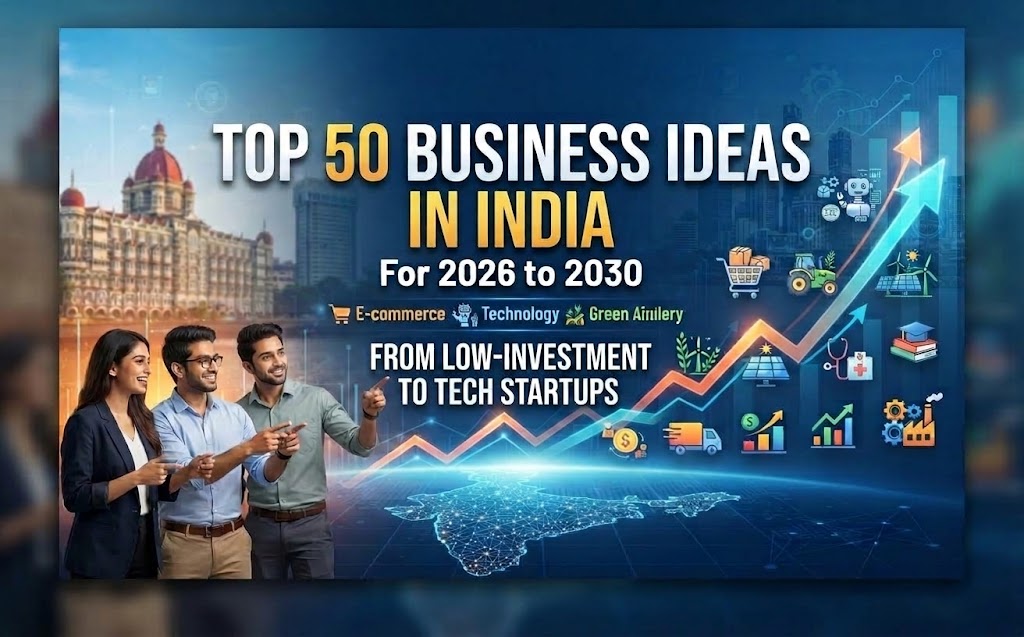

In 2026, we forecast investment, government policy and consumer trends will intersect in 10 key areas. These will be the strongest industries for new business creation in India. These areas will include EdTech, FinTech, HealthTech, AgriTech, Vertical SaaS, Home Services, Logistics, EV and Sustainability, D2C eCommerce and the Creator Economy.
This report will identify 50 associated business ideas and provide insight into the opportunities, the verticals this business may serve, and potential markets. Barriers to entry may vary and include access to markets, first-mover advantage and the ability to create a scalable business.
If you want to establish a business in India, you must be aware of rising markets and consumer demand. Understand your target audience, what resources you need to be first to the market, what barriers to entry exist and what your competition will look like. The information you need to start a business and gain a competitive edge may differ depending on your resources and your target audience.
The ideas may not be new, but the window of opportunity to take action may be limited. There are many new markets and opportunities in India. The focus is shifting away from technology-based startups.
Of course, its also worth remembering that the best business ideas arent necessarily completely new and original. Often, theyre variations on existing themes.
For example, a business idea could be a more convenient or user-friendly version of a service thats already available. And of course, technology can be used to help a business idea gain a competitive edge and boost its chances of success.
Most lists of the "top business ideas in India" cant seem to agree on anything. And one of the main reasons for this is the high rate at which Indian businesses fold. Approximately 90% of Indian startups close within the first five years, according to the study conducted by the IBM Institute for Business Value and Oxford Economics. The figures are staggering, but theyre meant to highlight the opportunities rather than discourage you from pursuing your business idea.
All the points below are supported by actual information about India, as opposed to unoriginal ideas found in a US business report.
According to some, entrepreneurs should be able to locate ?50,000 and a WhatsApp number to begin a business. Others require far more than that to fund and found a business. Still, no one knows for sure. The best-case scenario is that people are signalling an intent to found a business in 2026 to 2030.
Of course, it is critical for the founder to evaluate potential customer demand. It is the founders job to perform the analysis to determine if the business will be financially viable. The founder is responsible for performing an analysis to gauge a businesss viability and to determine if a business will be successful.
Every idea had to pass at least one of these three tests to make the list: There had to be evidence of actual funding or customer demand for the idea in 2026, starting a business with that idea had to be realistically within the means of a first-time founder, and the product had to be something that Indian consumers (not Americans or Chinese) would be willing to buy.
A lot of lists that are published at the beginning of the year have the same 50 ideas over and over again. Thats because ideas that dont make it onto the list based on at least one of the tests above get cut.
The businesses that made this list dont all require the same level of infrastructure. A small, family owned business has different growth potential than a technology business. A business can be small and successful without requiring further growth and investment.
India’s startup scene has exploded in the last few years. In 2026, the focus of the countrys startups and their funding shifted to profitability, and away from things like growth and expansion like before.
This shift is the reason that businesses that rely on customer acquisition through discounts and other promotions, for example, have a more difficult time raising funding, while businesses in other, more focused areas, like HealthTech and FinTech, for example, have no issues raising funding.
AI-focused startups have also gained traction in the last few years. Similar to before, 50 ideas in this list dont need the use of Artificial Intelligence to be successful.
For a first-time entrepreneur, this knowledge is crucial. Building a business in India does not mean founding an AI company or any company backed by VC capital. There are several other options including a localized services or e-commerce business, Software Product Company or a localized SaaS company.
One such pattern is, founders should evaluate idea viability based on funds actually in hand, as opposed to funds to be raised. Certain business ideas like setting up a tutoring center, starting a cloud kitchen, or opening a dropshipping business can be launched for less than 50,000 INR. Starting an EV charging or a Cold storage facility cannot be started for less than 5 Lakhs. The business ideas should also be evaluated based on the growth pace which the founder expects from the business.
Second, founder-market fit is more important than founder-interest. It is easier for a person with banking experience to start a fintech company, and for a person with a clinical background to start a health tech company. Starting a company is a long and arduous process and industry experience can help a founder avoid wasting time and money on mis (un) – prioritized opportunities.
Third, don’t believe the hype. There are plenty of examples of successful businesses, but that doesn’t mean the business model is exportable. For example, most people would agree that starting a food delivery business in India would be more successful than starting one in the U.S. given the vast difference in population density. However, that doesn’t mean starting a food delivery business in India would be easy or successful, especially if you don’t have a working knowledge of the food delivery business.
Lastly, it’s generally better to validate your idea before building it. For many ideas you can use no-code or low-code solutions to easily validate your idea, while for others you will have to build and code a product to verify if there’s a market opportunity. Before you raise money or build a product, determine if you have to build a product to validate the opportunity, or if you can easily prove there is a market using low-cost, quick solutions.
Around 50 business concepts are given here. These are for business opportunities in the Indian market for 2026. Some of these have relatively lower entry barriers while others require larger technology, infrastructure, and partnerships and regulation multi-year investments. Not all these concepts are of similar nature. Some have the potential to be large, complex businesses. Others like local service businesses can be small and not as complicated.
D2C & E-Commerce Business Ideas
The D2C market in India has space for focused brands. It is not as viable for brands that want to be everything for everyone. For success, a D2C brand should know fulfilment and customer experience. It helps if the brand knows its positioning and audience.
A focused brand can create and own a space for itself in the market. It can use different online and offline platforms to sell and promote its products. Use of social and print media and Apps can also help it do business directly.
With focus on specialised products, personal care brands can use raw materials, herbs and plants that are used in Ayurveda. These brands can educate customers about benefits of different products and differentiate themselves from general personal care brands.
The concept of subscription is useful in product categories like food, personal care products, books and other products. Success of this model depends on customer retention and stronger focus on repetitive purchases.
Entrepreneurs can start businesses by marketing private-label products on e-commerce platforms (i.e. Amazon, Flipkart, Meesho, etc.). However, these businesses have potential to grow beyond a marketing dependency on these platforms to build and market distinct brand names.
There is consumer interest in purchasing refurbished electronics (i.e. phones, laptops, etc.), and starting a business to market these products would require verification of the refurbished units and providing a warranty. This business would require staff to provide after-sales service.
SaaS & B2B Tech Business Ideas
Indian enterprises are willing to purchase enterprise software to resolve a specific business challenge. Therefore, developing specialized B2B and vertical market software and applications is a promising business idea.
Instead of building software for every business, founders can create a platform specifically for industries such as clinics, schools, logistics companies, real estate firms, or restaurants. Industry-specific workflows can make the product more useful than a generic solution.
A CRM application would be useful to small businesses, as most businesses use WhatsApp to communicate with customers. A Centralized application to manage customer interactions by integrating lead and follow up management would be useful to small businesses.
Business automation can be achieved by software to extract data from various business documents and forms. Similarly, automation of data entry from business invoices can be achieved with business software.
Providing a user-friendly no-code tool allows small businesses to build their own custom websites and applications. The ideal product focuses on a particular business market to simplify the adoption curve.
MSMEs must have simple and affordable options to digitize their HR and admin processes. Attending to the payroll and employee administration needs of businesses is one of the largest and fastest growing segments in the Indian SaaS market.
FinTech Business Ideas
Large-scale disruption in the Indian financial landscape provides ample opportunities in the fintech space. Starting a financial services business requires analysis of a range of legal and regulatory frameworks.
Technology can enable lending and other financial services. However, Founders must evaluate the legal and regulatory frameworks to validate the opportunity and structure the right partnerships, prior to building a business in this space.
A simple yet compelling product to engage and educate users on the world of investing has massive potential. Regulatory frameworks and best practices will shape product development and help protect users’ interests.
Nearly all small business owners and entrepreneurs will benefit from tools that simplify the collection, filing, and reporting of invoices and GST. Automation will eliminate manual data entry.
Many customers, rightfully so, have little to no confidence in choosing the right insurance policy. An Insurance tech comparison and platform product has tremendous potential to build trust and ease customer frustrations.
With over 30 million NRIs, providing hassle-free, secured, and controlled digital and cash remittance services is a large, untapped opportunity in the cross border payments space.
HealthTech & Wellness Business Ideas
Healthcare technology can address access, convenience, scheduling, communication, and administrative problems. The strongest opportunities are often those that solve a clearly defined healthcare workflow rather than attempting to replace healthcare professionals.
A combination of telehealth and e-pharmacy services is legally permissible and provides a robust product offering. Appointments, communications, and records management form the basis of a product and service offering.
Similar to the different modes of booking and discovering travel and wellness services, users should be able to do the same to mental health professionals. It is important for the platform to incorporate mechanisms to protect user data and ensure secure communication.
In an informational system, AI may be able to help users understand potential next steps based on their symptom presentation.
Users should be able to access home nursing and elder care services in a similar manner to other services via a mobile application. The application should allow users to manage bookings, and view caregiver schedules and payment information.
Employees should be able to access wellness programs offered by their employers via a centralized location. The program should be able to collect and report data to the employer.
EdTech & Upskilling Business Ideas
Users are interested in learning to help them achieve specific professional and academic goals. They want flexibility and control over their learning to integrate it into their busy lives.
There is a growing need for professional and technical education in Indian languages.
There are many specific questions asked on various civil services examinations. An app focused on these question types can be useful to prepare for the exam.
There are many web and mobile applications focused on helping users learn new skills and careers. These apps should focus on delivering lessons in an asynchronous format. These lessons should be short enough to be completed during breaks throughout the day.
Users (students and professionals) can access career counsellors and training as well as search and apply for jobs on the platform. Success of the product will depend on its recommendation system and ability to match users to jobs.
Technology is constantly changing and automating the world of work. Therefore, it’s imperative that students develop coding and AI skills. There is a strong case for starting a tech, coding and AI bootcamp.
Agri & Food Business Ideas
Indias agriculture industry continues to flourish. Furthermore, there is increasing demand for safe and hygienic food. Many food businesses have thrived as a result of the transition to online food ordering and delivery. A centralized system can improve connectivity for farming and food supply.
A subscription model allows customers to order dairy or vegetables directly from local suppliers.
A platform allows farmers to source inputs for agricultural production such as machinery, seeds and fertilizers.
A kitchen can prepare and cook food for multiple clientele.
A Website and/or mobile app can link farmers to cold storage transport services.
These foods target health conscious consumers. Starting with a few products and assessing customer demand can inform product line expansion.
Local & Home Services Business Ideas
These services are not centralized. Customers locate service providers with, for example, the help of telephone or text messages. With technologies that improve service provider-customer connections, new business opportunities may arise without changing the service offerings.
Customers can use the service to schedule appliance repair.
A mobile application can allow customers to schedule salon and spa services to be performed at their home. The mobile application can also be used to pay for the services and store customer service history.
The platform will serve as a reference point for busy parents and students in need of tutoring services. The services will be organized by subject and provided by tutors in the area.
Planning a successful event requires the use of various service providers, such as a photographer, a florist, and a caterer. An event planning marketplace can provide a one-stop shop for event service planning.
A web-based service can connect customers with moving services, enable customers to schedule moves, and serve as a point of communication between the customers and moving services.
Logistics & Quick Commerce Business Ideas
Quick commerce has changed consumer behavior and created the necessary logistics infrastructure to support a delivery business. This means focused logistics businesses have a better opportunity to thrive, as compared to other general logistics businesses.
Customers are willing to pay for 10 minute delivery of certain goods, such as over-the-counter medications, perishable goods, and pet supplies.
There are a number of off-the-shelf logistics management software packages. If a business has a high level of expertise in logistics management, then it may be worthwhile to have a custom logistics management software developed.
Operating an electric delivery fleet using two-wheelers can help businesses improve their finances and their positive impact on the environment. Using fleet management software can help deliveries become more organized.
Electric two-wheelers can support delivery businesses looking to reduce operating costs and transition towards electric fleets. Fleet management software can help track vehicles, drivers, charging, and deliveries.
Small and medium businesses may want to outsource fulfillment to focus on their core business functions. Outsourcing fulfillment may also allow businesses to avoid the capital expense of building warehouses.
EV & Sustainability Business Ideas
The planet is changing and so are customer preferences, governments, and technology. These trends offer new business opportunities in sustainable living and electric and renewable energy services.
No one can deny that the future is electric. Starting an electric vehicle charging business is a good long-term business opportunity. There are many aspects of this business that require good management, such as choosing the right location, maintaining the chargers, and collecting payments.
Electric two wheelers can be accessed through rental or subscription models, which eliminate the need for outright ownership. Back end systems can manage the fleet and customers.
Start-ups can provide solar installation and related services, and can also capitalize on the solar financing opportunity. Solar monitoring and maintenance further augment the service offerings.
The service combines waste collection and recycling with technology to offer an organized and systematic way to collect, transport and process waste and recycling.
Businesses increasingly need packaging alternatives for e-commerce, food, retail, and manufacturing. A specialised supplier can focus on recyclable, reusable, or lower-waste packaging solutions.
Content, Creator & Digital Media Business Ideas
Indias creator economy continues to generate opportunities beyond content creation itself. Businesses can support creators through production, brand partnerships, editing, distribution, monetisation, and technology.
A platform focused on regional audiences can serve viewers looking for content that is not adequately represented on mainstream platforms. A specialised audience can be a stronger starting point than trying to compete across every category.
Creators often need help with brand deals, campaign management, contracts, content planning, and reporting. An agency can provide these services while building relationships with brands.
Businesses can produce educational, informational, or entertainment content without relying on an on-camera creator. AI and automation can support parts of the production process while human editing remains important for quality.
A podcast studio can provide recording, editing, distribution, sponsorship support, and content repurposing. Businesses and creators can use such services without maintaining their own production setup.
Small businesses need websites, social content, marketing creatives, product descriptions, presentations, and other digital assets. An agency can combine AI-assisted workflows with human strategy, editing, design, and business understanding.
Not all businesses require a mobile app at the very start. A business may start off as a local tutoring service, small food business or a home service business. At first, such businesses can use methods like social media, bookings through WhatsApp or Landing pages to validate customer demand. Sometimes, unnecessarily investing on mobile apps or other technology can increase business costs.
As the customer base of a business grows and the business processes become repetitive and complex, for example, if a business has to manage several customers, bookings, payments, inventory, and other things, then investing on technology can simplify business processes. SaaS businesses or businesses which operate through a digital platform or offer online classes, must develop mobile apps as technology is core to their business. Similarly, businesses which offer services or products and have to cater to their customers through delivery must develop mobile apps, as such businesses are bound to have a large customer base and repetitive business processes..
When a business idea has gained traction, the next important step is transforming the idea into something which customers can purchase or use. Corewave provides such technology services.
Located in Noida, India, Corewave develops software products for businesses worldwide. Products include mobile apps, web apps, desktop apps, and automated business processes. The Corewave team builds products for business clients to help address software requirements for their businesses.
Product development strategies vary depending on the target clientele. Start-ups are encouraged to build a minimum viable product (MVP) to gain product validation. A core feature of Corewaves service is software development for the automation of business processes. Additionally, the company develops customer and employee portals and other custom software.
Corewave develops mobile and web apps for clients. A mobile app or web-based product may include back-end and/or real-time notifications. A product may be developed for logistics companies to help manage and track their business fleets. A product may also be developed for a client to help manage and operate a marketplace.
While using technology to implement a business idea, it is important to evaluate customer behavior to ensure that software developed aligns with core business requirements. Corewave helps prospective clients transform a business concept into a digital product. The Corewave team builds digital and web-based products for clients including websites, mobile applications, software as a service (SaaS) products, and automated business software.
As a mobile app development and software development company, Corewave apprehends business requirements first and decides on the appropriate technologies, features, architectures and development methods.
If your 2026 business idea depends on a website, mobile application, SaaS product, marketplace, CRM, ERP, or custom business software, Corewave can help you move from an initial concept to a working digital product.
As a mobile app development and software development company, Corewave focuses on understanding the business requirement first and then selecting the appropriate technology, features, architecture, and development approach.
There is no single business that works for every founder. The right opportunity depends on available capital, industry experience, customer demand, competition, location, and the founders ability to execute the business model.
Some service businesses, tutoring models, small food businesses, online selling, and certain home-based businesses can be started with relatively low initial investment. The actual amount depends on equipment, marketing, licensing, inventory, and operating costs.
Marketplace, booking, delivery, education, healthcare, customer-service, logistics, and subscription businesses can benefit from mobile applications when customers need frequent access or real-time interaction. However, an app should be built when it solves a genuine business requirement.
SaaS can be an opportunity for founders who can identify a specific business problem and build a product customers are willing to pay for. Vertical SaaS can be particularly focused because it targets the workflows of a defined industry.
The cost depends on the number of features, platforms, UI/UX requirements, backend architecture, integrations, security requirements, and development approach. A simple MVP can cost considerably less than a full-scale marketplace or enterprise application.
The answer depends on how customers will use the product. A website may be sufficient for discovery and early validation, while mobile app development can make more sense when users need frequent interaction, notifications, bookings, tracking, or account-based services.
No. A business can initially operate with existing tools, spreadsheets, no-code platforms, WhatsApp, or third-party services. Custom software becomes more valuable when standard tools cannot efficiently support the companys workflows or when software itself is the product.
A software development company can help translate a business requirement into product features, UI/UX, technical architecture, development, testing, deployment, integrations, and future improvements. The exact involvement depends on the startups requirements and internal team.
SaaS development generally creates software delivered to multiple customers through a subscription or recurring model. Custom software development is usually designed around the specific workflows and requirements of one business or organisation.
Yes. An established business may use mobile app development for customer bookings, loyalty programmes, field operations, employee management, ordering, payments, communication, or service tracking. The benefit depends on whether the app improves an existing business process or customer experience.
Validate the customer problem, identify the target audience, study competitors, estimate operating costs, understand regulatory requirements, and test whether people are willing to pay. Where possible, start with a low-cost validation method before making a large investment.
Yes. Corewave can help businesses turn a validated concept into an MVP by defining the required features, designing the user experience, developing the product, testing it, and preparing it for real users. The MVP can then be expanded as the business grows.