First Timer’s Guide to Agile Mobile Development: Exploring the different phases of mobile app development
Learn moreSwipe to Check More

The real estate market in Dubai is always advancing, and so is the way customers can browse, differentiate, and buy property. An apartment buyer in Dubai Marina may not ever step foot in a traditional property office. Instead, potential buyers are seeking properties on the internet via their phones. They are comparing prices, checking the location via a map, looking at photos or virtual tours, saving properties, and contacting agents to schedule viewings via the internet.
This makes a variety of things possible for property management, real estate development, and investment corporations. A mobile application that is designed well and built well can transform the way property is offered. It can create a property marketplace, channel leads, operate as a program for property management and investment CRM tools, among others. Activity in Dubais market makes this an even bigger opportunity. The Dubai Land Department (DLD) revealed that in 2024, there were 226,000 real estate transactions in Dubai, totaling AED 761 billion. This is an increase of 36% in transaction volume and an increase of 20% in transaction value relative to 2023. The DLD also stated that there were 2.78 million real estate procedures that year, which included both transactions and rental agreements. This is an increase of 17% relative to 2023.
So, if you want to build a property application, one of the first and most obvious questions you may have is:
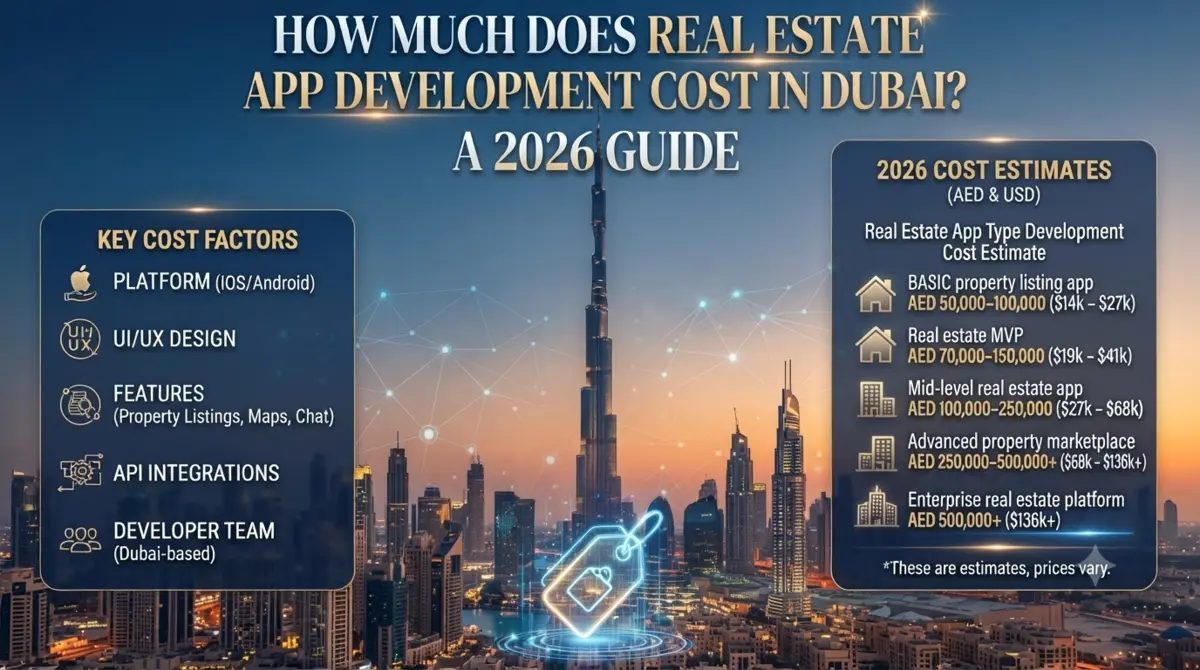
On average, a real estate application may cost anywhere between AED 50,000 to AED 500,000 (or more). An MVP with basic property listings may cost between AED 50,000–100,000. Meanwhile, a highly advanced marketplace or investment platform or an enterprise real estate application ecosystem may cost AED 250,000–500,000 (or more) to build. Just looking at the price is not enough. Because of this, it’s also essential to factor in what will ultimately be built for you at that price, the app features that will influence the budget, the amount of time app development will require, and the app type that is most beneficial to your company.
Let’s jump into the details!
The cost of building a real estate application in Dubai does not have a set value because of the varying needs of each business. Planning costs for real estate app development are somewhat predictable as defined here:
| Basic property listing app | AED 50,000–100,000 |
| Real estate MVP | AED 70,000–150,000 |
| Mid-level real estate app | AED 100,000–250,000 |
| Advanced property marketplace | AED 250,000–500,000+ |
| Enterprise real estate platform | AED 500,000+ |
These costs may vary and are largely driven by the location of the development team, cost of technical infrastructure, number of platforms required, cost of UX/UI design, ease and number of integration services, level of security and other custom requirements, functionality, and scalability. There is no industry standard for a "real estate app." A simple property listing app is completely different from a Property Finder-style marketplace, and both can be classified as real estate apps. Because of this, scoped development is the best way to get a reliable estimate.
Another reason apps and digital platforms are in demand is the size of Dubai’s property market. According to the DLD for 2024, the value of property transactions reached AED 761 billion, with 217,000 recorded investments totaling AED 526 billion, and 110,000 new investors entering the market, a 55% increase. [1] These statistics tell a story, especially for technology companies.With a market this large and with hundreds of thousands of investors, you need digital tools to buy and sell property, manage listings, generate leads, communicate with clients, and manage data. This demand is not just for local buyers. Dubai has international investors, expats, landlords, tenants, and a wealth of buyers.
Now, a modern real estate application might have to handle numerous customer journeys simultaneously.
The off-plan property market is another growing area of focus. According to Property Finders 2024 Market Watch, Dubai saw a total of 180,987 sales in 2023, for a total transaction value of approximately 522.5 billion AED. Of these, 109,527 transactions were off-plan, accounting for a 60.6% increase in transaction volume year on year. The off-plan sales transactions valued around 228.03 billion AED, reflecting a year on year growth of 43.5%.
So what does this have to do with app development?
Usually, off-plan property listings mean a new type of digital experience versus a standard resale property digital experience.
For example, a developer may want to include the ability to display any of the following:
This means, if you are focusing on Dubais off-plan market, you may be required to build a lot more than a standard property listing app.
The app may function as a digital sales center for the entire development.
Developers are usually the worst at estimating/appraising how much a project is going to cost because the project scope isnt defined. Simple looking screens, for example a property search screen, can be very complicated. They may include very complex back end databases that contain thousands of properties, filtering logic, mapped APIs, image storage and retrieval, authentication, integration with analytics and CRM tools, and many more advanced features. There are many more aspects to consider when estimating the cost to develop a property listing app.
Are you…
Each of those needs a different application.
For a real estate agency, you would need lead generation and agent management.
For a property developer, you need the ability to showcase projects and book units.
For a property marketplace, you need accounts for buyers, sellers, agents, and admins.
For an investment platform, you would need features for financial calculations and portfolio analytics.
Generally, the more elaborate the business model, the more elaborate the application technology.
If you are looking for a mobile application, there is a major trade off to developing separate native applications for iOS and Android, because, for each platform, you need to do the full development, testing, optimization, and maintenance.
For most applications, cross-platform development is the best approach.
A company with a business plan may need more sophisticated solutions than a startup that needs a basic product to validate a concept.
Real estate is a very visual industry.
Users of this type of application want to able to see properties right away and want to be able to view important information without having to click through multiple screens.
Strong real estate apps should allow users to answer the following questions easily:
Because of this, UI/UX design can strongly impact the overall cost of developing real estate mobile apps. Professional design requires user flows, wireframes, prototypes, and interface design, and also responsive layouts, usability, and testing considerations. Proper design of the app helps eliminate unnecessary friction in the user experience of discovering new property listings.
A mobile app represents only the visible part of an end product. The mobile app is supported by a backend that manages users, properties, searches, enquiries, agents, messages, images, and other data.
A small real estate agency could have a simple backend. A marketplace with during business hours thousands or millions of property records would have a much more complex and scalable architecture.
The backend may need:
Because of this, two apps requiring a similar design could have very different overall development costs.
Real estate apps often require several third-party integrations, which can greatly influence costs. Depending on the app’s business model, integrations can be required for CRM systems, payment gateways, maps, SMS and email, analytics, property data, cloud storage, calendars, and identity verification. With so many potential integrations, developments will be required for each app. This includes development, authentication, testing, error handling, security, and maintenance. An app will take considerably more time and require a larger budget as it scales to more integrations compared to an app with low integrations. Because of this, the needed integrations should be established during the planning and cost estimation phases.
There are certain features that a real estate app should at least have.
Users should be able to register an account via email, phone number, OTP, or social media.
Users should be able to search properties based on multiple criteria, including location, price, property type, number of bedrooms or bathrooms, size, and furnishing.
A property listing should contain images, descriptions, price, amenities, a floor plan, a listing agent, and the property’s availability.
Users should be able to list properties that they want to view later.
Offers a visual method of searching property that is based on location.
Users can ask agents or developers for information.
Users can be notified of new listings, changes in property pricing, appointments, and responses to enquiries.
The business needs to manage users, manage properties, manage enquiries, manage agents, manage content, and manage reports.
The features can create the building blocks of a real estate MVP.
When the basic application is complete, advanced functionalities can be added to the application.
AI can tailor property recommendations to users based on their activity and preferences. Let’s say a user searches two-bedroom apartments multiple times with specific pricing and a specific location; then the application can show that user an ample amount of those listings. This can help the users think that the application is more personal. AI should be added to the application if there is a need vs. not adding it because it’s the trend.
Virtual tours may be the best option for buyers in Dubai who may not be Dealing with local buyers. If potential buyers do not live in the UAE, they may want to see a property virtually before making the decision to travel to the UAE to view it in person. A virtual tour can be 360-degree views, a video with a guided tour of the walk, a tour with an interactive floor plan, or a fully immersive tour. The more features that you want, the more advanced technology and the more content that will be needed.
Many property investors are drawn to Dubais property market. Many just don’t have enough information with a standard property description to make a property investment. Rental yields and ROI need to be assessed. This can mean comparing various properties, estimating future returns, managing an investment portfolio, and assessing various market and property metrics to make an investment. Rather than just property discovery, a business can offer an investment property experience to its users by incorporating these features into a real estate application. Development of a real estate application can incorporate investment analytics, financial calculations, and portfolio tracking along with other market analytic features. These features come along with supplemental sophisticated data processing and backend functionality, thus impacting the overall cost of real estate application development.
| Technology Layer | Common Technologies | Purpose in a Real Estate App |
|---|---|---|
| Mobile App Development | Flutter, React Native, Swift, Kotlin | Used to build iOS and Android applications |
| Backend Development | Node.js, Laravel, Python | Handles business logic, APIs, authentication, and application functionality |
| Database | PostgreSQL, MySQL, MongoDB | Stores property listings, users, enquiries, transactions, and other application data |
| Cloud Infrastructure | AWS, Microsoft Azure, Google Cloud | Provides hosting, storage, scalability, backups, and cloud-based services |
| API Integration | REST APIs, GraphQL | Connects the application with CRM, payment, maps, property data, and other third-party services |
| Security | SSL/TLS, OAuth, JWT, encryption | Protects user accounts, property data, transactions, and sensitive business information |
| Analytics | Google Analytics, Firebase Analytics, custom dashboards | Helps businesses understand user behavior, engagement, and application performance |
An MVP for a startup and a large property marketplace may require very different frameworks.
The cheapest development company is not always the optimal choice to reduce costs. Its focus should be avoiding unnecessary complexity. The best option is to go for an MVP. What is the most basic offering that supports the primary customer journey? You may find that the basic functionalities are property search, see property details, and make enquiries. You should include these basic features and leave additional features like AI recommendations, AR, and investment analytics to a later stage to be included once you have a user base. Defining the requirements early and leaving minimal scope of work will keep the costs low. Choose a technical architecture that supports your business. It may cost a little more in the beginning, but it will be a lot less than a rebuild of the entire platform later.
The lowest price is not always your best option. Development partners should understand technology and the real estate workflow. Evaluate the following before making your choice.
Have they built real estate platforms, marketplaces, CRMs, and similar business apps?
They should be able to discuss architecture, APIs, and security, along with scalability, testing, and the cloud.
You should know what is and isnt included in a quote.
Be sure to know who owns what before signing.
How will they handle bugs or updates in the future?
A good project and development journey goes beyond great engineering, poor communication will always make a project a failure.
The right development partners should be able to balance the workflow and make decisions while keeping communications aligned.
We can only expect more personalization, automation, and smart data in the future of real estate applications. AI can identify the best properties in relation to the users needs. Real estate can be viewed using virtual tours. Data analytics can identify the best investments. Automated responses can assist agents in communications. Add in contextual location data and the property market in Dubai is primed and ready for these innovations. According to DLDs 2024 annual report, transaction activity surged, and 2024 saw the average price per square metre reaching new highs for units and villas. Villas showed the strongest appreciation for the last four years. [3] This trend reminds real estate markets of the fast-changing nature of their business and the need to create simple digital property search interfaces. For a winning application, a sound digital strategy is necessary, but not sufficient. The most successful real estate applications will be the most frictionless from a customer perspective.
The cost of app development can range anywhere from AED 50k to AED 500k in Dubai. You can expect to spend AED 50k–150k for a basic property listing MVP, while advanced property marketplaces and enterprise level applications will be in the range of AED 250k–500k+. Costs are relative to the level of required app features, what platforms will be supported, the level of customized design, the amount of added security, the required integrations, and app scalability.
A basic property app can start at AED 50,000 for a minimum viable product (MVP) and costs can increase significantly based on the desired advanced functionality. More advanced property apps with integrated CRMs, payment processing, AI, built complex backends, virtual tours, and multiple user roles tend to go beyond a basic budget.
A minimum viable product (MVP) for a basic Real Estate app can take 2 to 4 months to build. For a more complex app, based on advanced features and integrations, the estimated time can be more than 4 to 8 months.
A basic app should have user accounts, property listings, search with filters, maps with property details, admin panels, and user enquires. More advanced apps can have user favorites, chats, integrated CRMs, payment processing, AI based recommendations, virtual tours, analytics, and investment tools.
It really depends on the business. Ready-Made Software can be a good option for businesses with standard use cases. Custom development is better for businesses that have a need for unique workflows, specialized functionality, custom integrations, full control, and long-term scalability.
App maintenance costs are dictated by the level of complexity and the apps framework. App hosting, APIs, and security incur monthly costs. Bug fixes and OS updates, along with the costs of app maintenance and monitoring, are unending. Flexible budgeting for maintenance and updates is encouraged.
Startups employ an MVP due to cost and productivity factors. Startups can design an app with a basic user interface (UI) for property searches and inquiries to launch first. User feedback can drive the construction of additional UI options for features that are in high demand.
A Property Finder-type app requires more funds than a simple app with a property search feature. Property Finder-type apps also have large-scale trade and marketplace solutions. Multiple user roles and advanced property and agent features add to the cost. Apps of this kind can exceed AED 250,000–500,000+.
Basic apps for the Dubai market can start at AED 50,000. A basic app with features for advanced property searches can reach AED 250,000. Property marketplace apps can cost AED 500,000+. Advanced apps that require multiple user roles can exceed this amount. The most cost-effective app is not always the cheapest.
Dubais real estate sector hit an impressive AED 761 billion in 2024, with around 226,000 real estate deals and nearly 2.8 million total real estate activities. The sector drew another 110,000 new investors.