First Timer’s Guide to Agile Mobile Development: Exploring the different phases of mobile app development
Learn moreSwipe to Check More
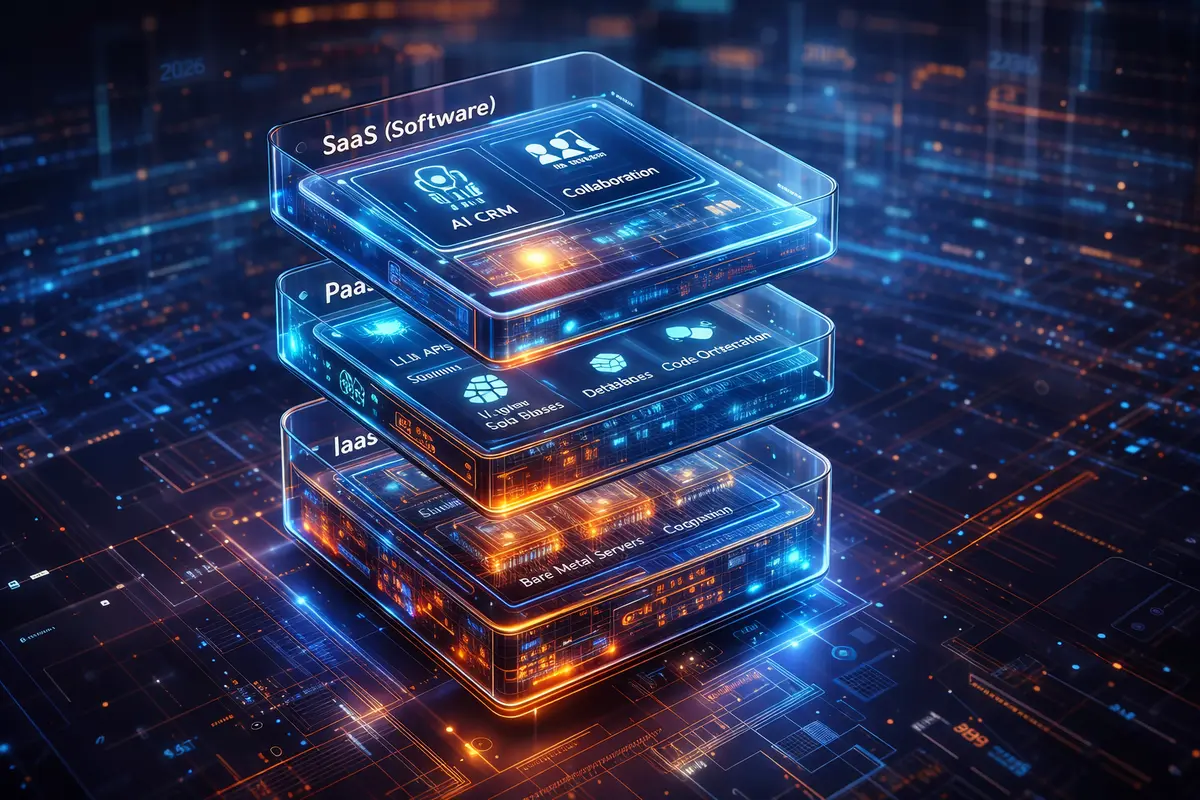

In the rapidly changing technological environment in the year 2026 the cloud has gone beyond a storage solution to become the main engine for global innovation. For modern companies it is not concerning "moving to the cloud," instead, it is about designing for scalability, intelligence and ROI. As we traverse the complexity of AI-native development as well as autonomous workflows the decision between Infrastructure as a Service (IaaS), Platform as a Service (PaaS) as well as Software as a Service (SaaS) is now the most important decision on a CTOs road map. If youre a start-up in the burgeoning tech industry of Jaipur or a multinational corporation the model of service you choose will determine your operational flexibility and ability to incorporate new technologies such as Generative AI and Edge Computing.
The global market for cloud services in 2026 will be described by "Inference Economics"--the cost and effectiveness of operating AI models at a scale. A mistake in your service model could result in "Cloud Sprawl," where costs rise to the point of being uncontrollable while performance declines.
We at Corewave we have observed that companies who align their infrastructure with their specific growth stage have an increase of 40 percent speedier time-to-market. This guide is an in-depth blueprint to help you understand the clouds structure and choose the right model that doesnt only aid your business, but actually improves it.
To comprehend the cloud 2026-era, think of it as an advanced manufacturing facility.
IaaS is the factory floor that has water and power; you bring your own equipment and employees.
PaaS is a factory that is equipped with the most modern production lines. You simply take the raw ingredients (code) to make the product.
SaaS is the final product that is delivered to your doorstep and you utilize it to reach the objective.
The Shared Responsibility Model in 2026
One of the most common mistakes made by businesses is not understanding who is accountable in the area of security and maintenance. In the 2026 world security is an "Partnership."
The Providers Responsibility Hardware security, physical security, integrity, as well as core global networking.
The businesss (Your) responsibility: Data encryption, Identity and Access Management (IAM) and application layer security.
As a reputable service provider, Corewave stresses that even at SaaS level the responsibility for the way data is organized and exhibited to search engines rests at the level of the business.
In 2026, IaaS (Infrastructure as a Service) has gone beyond the simple virtual machines. It is now the "Silicon-as-a-Service" layer. For companies that need absolute control of their environments, IaaS provides the raw storage, compute and networking resources on demand.
Contrary to other models IaaS lets you handle everything from your operating system all the way up. It is the ideal option for businesses that deal with sensitive information or requiring custom-built architectures that standard platforms do not support.
The 2026 Shift: GPU-as-a-Service and AI Power
The most significant change in IaaS this year is the increasing democratization of GPU clusters. As Generative AI is becoming the core of business today, businesses shift their spending to GPU-as-a Service (GPUaaS).
Raw Compute Power: Accessing H100 and B200 Tensor Core GPUs, without the multi-million-dollar upfront hardware investment.
Custom AI Training IaaS is vital for companies that are that are developing custom LLMs (Large Language Models) where privacy of data as well as custom kernel enhancements are not negotiable.
Edge Computing: Decoupling the Data Center
In 2026, latency will be the main cause of user experience. Todays IaaS providers are currently using "Edge Nodes" closer to cities like Noida, Delhi, and Jaipur.
Real-Time Processing In addition to moving computing resources closer to the edges of networks, IaaS allows ultra-low latency for applications like autonomous systems as well as real-time video analytics.
Compliance and Sovereignty For companies operating in India localized IaaS ensures that sensitive data of users remains within the national borders, in line with the most recent DPDP (Digital Personal Data Protection) guidelines.
While IaaS provides the greatest control however, it requires the most advanced technical knowledge to manage. This is why partnering with a professional is crucial. As a leading mobile app development business, Corewave makes use of IaaS to build strong backends that are scalable and scalable for applications that anticipate thousands of concurrent users.
If were deploying an intricate matrimony platform or a high-frequency fintech application our infrastructure team will ensure that your IaaS configuration is optimized to:
Cost-Effective: Preventing "Idle Resource Drain" by automatizing instance scheduling.
Security: Implementing Zero-Trust networking at the hardware level.
Redundancy: Architecting multi-region failovers so that your business will never go offline.
If IaaS is the "foundation," then PaaS (Platform as a Service) is the fully-equipped "innovation lab." In 2026 the PaaS market will be an $140 billion business driven by the urgent demand for companies to launch applications more quickly than competitors.
PaaS takes away the hassle of managing middleware, operating systems and runtime environment. In the case of any mobile application development business this model can be a game changer because it lets developers concentrate on the their code and user experience instead of patches for servers or hardware configurations.
The Emergence of AI-PaaS (AIPaaS)
The major trend of 2026 will be the growth of AI-PaaS. Modern platforms now come with "Intelligence-out-of-the-box." Instead of constructing AI models from scratch developers can now make use of:
Integrated LLM Orchestration: Seamlessly connecting apps to models such as GPT-5 or Claude 4 directly through the platforms ecosystem.
Vector Database Integration Inbuilt support for data with high dimensions is crucial to build personalized recommendation engines as well as semantic search functions.
Automated Development Operations: AI-powered CI/CD pipelines which automatically optimize code to improve security and performance before it reaches the user.
As a top developer of mobile apps, Corewave utilizes the most up-to-date PaaS frameworks that transform complicated concepts into highly-performing digital products. Through the use of controlled platforms, we guarantee that your app benefits from:
Predictive Scaling PaaS-based platforms to 2026 will use AI to anticipate spikes in traffic (e.g. during a sale or an ad campaign that goes viral) and increase the size of resources prior to the lag begins.
Cross-Platform Efficacy: No matter if were developing with Flutter or React Native or Kotlin, PaaS provides a integrated backend that functions seamlessly across iOS, Android, and Web.
Lower Total Cost of Ownership (TCO): By cutting the requirement for an extensive internal DevOps team, we assist our clients to allocate their budgets to customer acquisition and innovation.
Industry Insights: "In 2026, the speed at which you develop is your biggest competitive advantage. PaaS allows Corewave Corewave to go from an idea to a real MVP that is scalable and expandable (Minimum Viable Product) in record time, making sure that our clients stay ahead the curve of market."
SaaS (Software as a Service) is the most prominent layer of cloud. By 2026, SaaS has evolved from "static software" to "Intelligent Ecosystems. " Users dont just "use" tools but interact with an AI-driven ecosystem which learns from their work.
Composable SaaS and Micro-SaaS Trends
We have entered the age of "Composable Business. " Enterprises are no longer purchasing massive single-purpose software packages. Instead they are creating custom solutions by connecting Micro-SaaS components via APIs.
Hyper-Personalization: Modern SaaS tools like CRM or ERP systems now use Generative AI to provide unique interfaces and insights for every single employee based on their role.
Vertical SaaS Growth Specialized software designed to specific industries, such as renewable energy management or matrimony services -- are seeing unprecedented use.
Security and Data Sovereignty in SaaS
With the worldwide push for data privacy 2026s SaaS providers have incorporated Zero Trust Architecture. This means that security is no anymore just an "add-on" but a core element of softwares DNA. making sure that data from enterprises remains secured and in compliance with local laws, such as Indias DPDP Act.
To win in the 2026 digital economy, you must choose a model that balances operational control with speed-to-market. Below is a high-level technical matrix designed to help CTOs and Product Managers align their infrastructure with their business KPIs.
| Feature | IaaS (Infrastructure) | PaaS (Platform) | SaaS (Software) |
|---|---|---|---|
| Primary Goal | Total Infrastructure Control | Accelerated App Development | Immediate Business Utility |
| Responsibility | You manage OS, Data, Apps | You manage Data & Apps | Provider manages everything |
| Best For | AI Training, Big Data, HPC | Startups, SaaS Builders | CRM, ERP, Productivity |
| Scalability | High (Requires DevOps) | High (Predictive/Auto) | Automatic (Built-in) |
| 2026 Focus | GPU-as-a-Service | AI-PaaS & Vector DBs | Intelligent Ecosystems |
Cloud computing isnt an end-to-end destination, it is in constant evolution. By 2027, the distinctions between IaaS, PaaS, and SaaS will be blurred even more by using "XaaS" (Anything as a Service).
The rise of Serverless (FaaS): The market for serverless worldwide is expected to reach $28 billion by 2026. This "No-Ops" approach allows businesses to run applications only when it is triggered by certain events, dramatically decreasing the cost of idle.
Autonomous Cloud Governance AI has now taken over the management of cloud services. From self-healing networks to automated cost optimization (FinOps) cloud is now an autonomous system that can optimize its own performance.
Data sovereignty in India: Following the DPDP Act (Digital Personal Data Protection), localized cloud nodes in Noida, Delhi, and Mumbai are becoming the norm for businesses that are focused on compliance with regulations and confidence.
Which model of cloud is the best for an AI start-up in 2026?
For startups requiring rapid iteration, PaaS (specifically AI-PaaS) is ideal as it comes with integrated LLM software and databases. For developing models that are proprietary, IaaS offers the required raw GPU power.
How can PaaS help to lower the development cost?
PaaS eliminates the necessity for costly infrastructure management as well as DevOps teams and allows companies to concentrate all of their budget on feature development.
Do you think SaaS more secure than IaaS?
Not necessarily. While SaaS providers manage security issues, IaaS provides you with the ability to create high-level custom encryption and zero-trust systems.
When should I consider IaaS over PaaS for my business?
Select IaaS for those who require total control of your operating system and security configurations that are custom or specific hardware (like specific GPUs designed for AI training). Choose PaaS If your primary concern is speed-to-market, and you wish to reduce the cost of managing servers as well as patching and middleware.
What is AI-PaaS? (AIPaaS) different from conventional PaaS?
Traditional PaaS provides the platform to host your codes. AI-PaaS provides the platform along with integrated AI tools, like Large Language Model (LLM) APIs vector databases to support semantic search and automated prompt engineering environments, drastically cutting down the time needed to create AI-based applications.
Can I utilize PaaS, SaaS and IaaS simultaneously?
Yes, most modern companies employ the hybrid cloud approach. For instance, a business might choose to use SaaS for their CRM (Salesforce), PaaS to build their own mobile app that is designed for customers as well as IaaS to host a high-performance, secure database warehouse to support big data analytics.
How can businesses reduce the cost of cloud services in 2026?
Cost optimization in 2026 will be based on FinOps strategies. This includes:
Autoscaling: Dynamically adjusting resources in response to demand changes in real-time.
Spot Instances Utilizing the clouds spare capacity to complete non-critical work at 90% discount.
Rightsizing Continuously reviewing and downsizing any instances that are more than the amount required.
Which model of cloud is the best for data security as well as compliance in India?
While all models provide security functions, IaaS provides the highest level of security to ensure conformity with Indias Digital Personal Data Protection (DPDP) Act. It lets you implement customized encryption protocols and select specific regions for data centers (like Noida or Mumbai) to ensure data sovereignty.
What exactly is "Serverless Computing," and is it part of PaaS?
Serverless is often considered to be an improvement on PaaS. It lets developers execute programs (Functions as a Service) without having to think about the server that runs it. Pay only for the precise milliseconds in which your code is running which makes it the most cost-effective option for workloads that are unpredictable.
Could a small business be able to afford IaaS for AI development?
Yes, through GPU-as-a-Service. Instead of purchasing a $40,000 GPU server startups can rent high-performance infrastructure from an IaaS service provider on a pay-as-you go basis which allows them to build and implement AI models with little initial capital.
The shift to cloud in 2026 is not about technology, its about business survival. Choosing between SaaS, PaaS, and IaaS is a crucial decision that impacts your security, budget and your capability to be innovative.
We at Corewave Corewave, we offer more than just services; we create solutions. Our team is adept at managing these layers to ensure that your digital environment is built upon a solid foundation that is safe, scalable, and smart.
Are you ready to maximize your cloud strategy? Contact Corewave Today for an in-depth review of your current infrastructure and a plan for growth in 2026.