




Custom CRM Development Services in Mumbai

Different businesses need different mechanisms to effectively manage their customers. The CRM solution of a real estate business needs to capture and manage property inquiries and visits. On the other hand, a logistics business may need to manage its accounts and communicate with them to provide its services. A CRM solution for a hospital may need to capture and manage customer appointments. A B2B business may need to manage its sales opportunities. Corewave understands all these unique business needs and provides customized CRM development services in Mumbai.

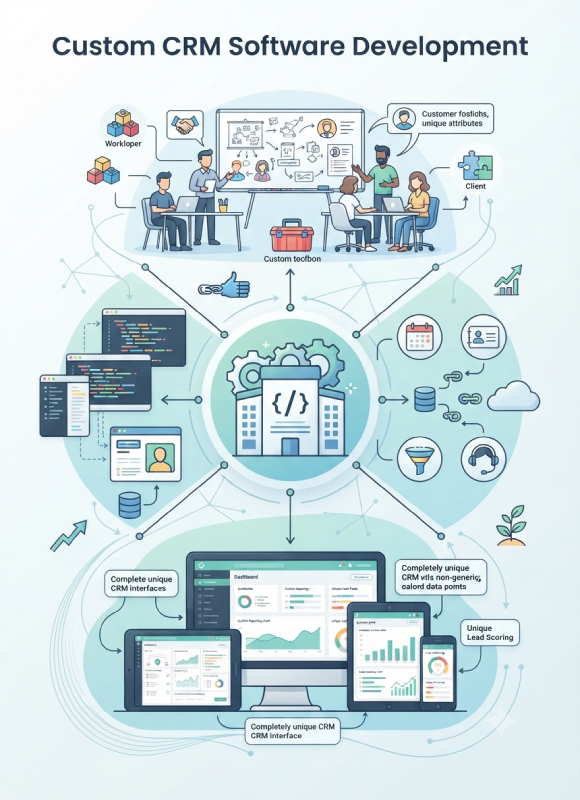
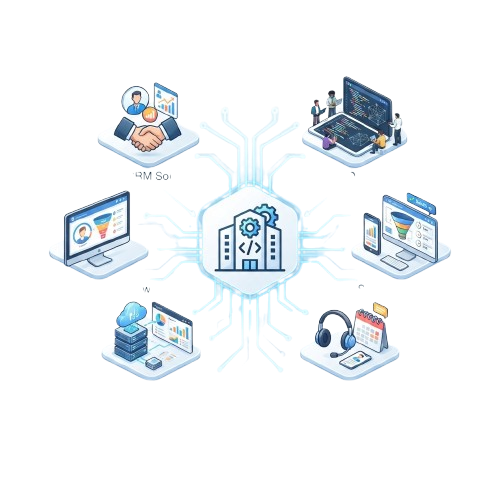
Our end-to-end development of custom CRM in Mumbai includes process documentation, UI/UX design, front-end and back-end development, database design and development, API development, integration, automation, testing, deployment and maintenance. We can help you build CRM solutions that integrate customer information with different business processes such as sales, marketing, service and support, communications, operations, reporting and more.

CRM Features We Develop

A modern CRM needs to support the complete customer journey rather than simply maintaining a contact database. Corewave develops CRM functionality according to the business processes and user roles involved.

Lead Management

Capture, assign, qualify, categorize, and track leads while maintaining complete information about their source, status, activities, and follow-up history.

Customer Management

Maintain centralized customer profiles containing contact information, interactions, activities, documents, notes, transactions, service requests, and relevant business information.

Sales Pipeline Management

Provide customized sales stages that allow teams to monitor opportunities, expected closures, deal values, activities, and movement throughout the sales process.

Tasks and Activities

Allow users to create, assign, prioritize, schedule, and monitor activities while helping managers understand pending and completed work.

Follow-Up Management

Create reminders and automated actions that help sales teams maintain timely communication and reduce the possibility of important customer follow-ups being missed.

Communication Tracking

Connect supported communication channels with customer records so authorized users can access relevant interaction history without searching through disconnected systems.

Custom Dashboards

Present business information through role-specific dashboards covering sales performance, leads, pipeline activity, customer engagement, support operations, and other relevant metrics.

Reports and Analytics

Generate customized reports that help managers understand lead sources, conversions, sales activity, customer behavior, team performance, and operational trends.

Customer Support

Manage support tickets, assignments, priorities, escalations, communication, internal notes, resolution status, and customer service activities within the CRM.

Role-Based Access

Define permissions for administrators, managers, sales representatives, support teams, and other users according to their responsibilities and access requirements.

Document Management

Organize customer-related documents and provide controlled access to relevant files according to user permissions and business workflows.

CRM Notifications

Trigger email, SMS, push, or in-system notifications for follow-ups, task assignments, status changes, approvals, alerts, and other predefined events.

Intelligent Search

Allow users to quickly find customer records, leads, opportunities, activities, tickets, documents, and other information through centralized search functionality.

CRM Software Development Services by Corewave

As a CRM development company in Mumbai, at Corewave, we specialize in complete CRM development, from frontend to backend. Along with developing CRM applications for you, we can also build other applications that integrate seamlessly with your CRM.

Custom CRM Development

We understand your business, create solutions for your sales team, and identify how your customers interact with your business. We generate reports your team will find useful and develop a CRM that adapts to your team's hierarchy and the various tasks your team members perform.

CRM Application Development

We develop CRM applications that let your team members access customer information from any computer or mobile device.

CRM UI/UX Design

We develop easy to use, and efficient CRM UI/UX Designs that include role-based screens and dashboards. Our interfaces include fields, tables, and other data displays along with efficient navigation systems and workflows.

CRM Integration Services

Using the right integration technologies, we connect your CRM with other business applications. When businesses transition from outdated or legacy applications, or from using spreadsheets, we can assist with moving your data to your new CRM.

CRM Data Migration

We can develop automated solutions for your CRM to perform tasks such as notifications and reminders, and change or update records based on team members' input and approval.

CRM Automation

Corewave can automate repetitive CRM processes such as lead assignment, reminders, notifications, status changes, approvals, task creation, and escalation workflows.

AI CRM Development

Corewave can build CRM applications with features such as AI powered customer support, and automated customer ticket classification and prioritization.

CRM Maintenance and Support

We provide ongoing support and maintain your CRM application by writing new code and integrating third party applications.

AI-Powered CRM Development

AI has different implications for the architecture and design of CRM applications. This is especially true for how CRM applications capture, process, and present data to users. AI has numerous applications and can influence automation, business rules, and suggestions in CRM applications. Corewave use AI in CRM applications to provide practical business benefits to customers. One example is providing a salesperson with an automated summary of past customer interactions before the salesperson makes a call to the customer. AI in CRM applications can classify leads, recommend communications to be sent to leads, assist in searching for data, suggest responses to communicate with leads, and perform other similar tasks.

Possible AI functionality includes:

  • AI Customer Assistant: Provide conversational assistance for supported customer and internal service workflows.
  • Intelligent Lead Classification: Categorize or prioritize leads using predefined business rules and AI-supported analysis.
  • AI Summaries: Generate concise summaries of customer interactions, activities, notes, or support conversations.
  • Smart Recommendations: Surface relevant customer information, products, actions, or next steps according to the defined use case.
  • AI Search: Allow users to search CRM information using natural-language queries instead of relying only on traditional filters.
  • Communication Assistance: Support teams with AI-generated drafts, summaries, or suggested responses where appropriate.
  • Workflow Intelligence: Use AI alongside predefined business rules to identify opportunities for automation and process improvement.

Not every CRM application should incorporate the latest trends in AI technologies. AI should be contextually introduced based on the data available, the business need, the requirements of the security and compliance framework, and the level of human oversight desired.

CRM Workflow Automation

CRM applications are constantly capturing and processing data. Some of this data is then used to define business rules which, when incorporated with workflow automation, can help eliminate the need for employees to perform mundane and repetitive tasks. For example, CRM applications can automatically assign leads to sales personnel, create follow-up tasks, and notify the salesperson of the lead.

Other automation possibilities include:

  • Lead Assignment: Automatically route leads according to location, product category, source, department, availability, or predefined allocation rules.
  • Follow-Up Reminders: Generate reminders based on lead status, previous communication, scheduled dates, or sales-stage requirements.
  • Task Creation: Automatically create tasks when specific events occur within the CRM.
  • Escalation: Notify managers when a customer request or support ticket remains unresolved beyond a defined period.
  • Approval Workflows: Route selected actions through appropriate managers or departments before completion.
  • Status Automation: Update records or trigger notifications when defined conditions are satisfied.

Automation can reduce repetitive administrative activity while helping teams follow consistent processes.

CRM Integration Services and API Development

Corewave offers CRM integration services to connect different CRM applications used by businesses to the other line of business applications, tools, and services used by the business. These may include email and communication applications, marketing applications, payment processing applications, accounting applications, ERP applications, business analytics and intelligence applications, and other custom business applications.

Our integration solutions encompass REST APIs, webhooks, SDKs, data-sync, assertion, and exception handling, and monitoring. Our clients have integration needs to provided email and SMS services, payment and telephony systems, calendar and scheduling apps, marketing and promotion, accounting and ERP systems, cloud and storage, analytics, and other business apps.

APIs, when used with CRM systems, provide flexibility and increase usability of the system, but can expose business and client data. A few of the CRM API threats identified by OWASP are broken object level authorization, function level authorization, and security of access controls, and third-party API consumption. During integration of CRM systems, control of access and exceptions, authorization and assertion, combined with right API architecture, would address the concerns identified.

Mobile CRM Development

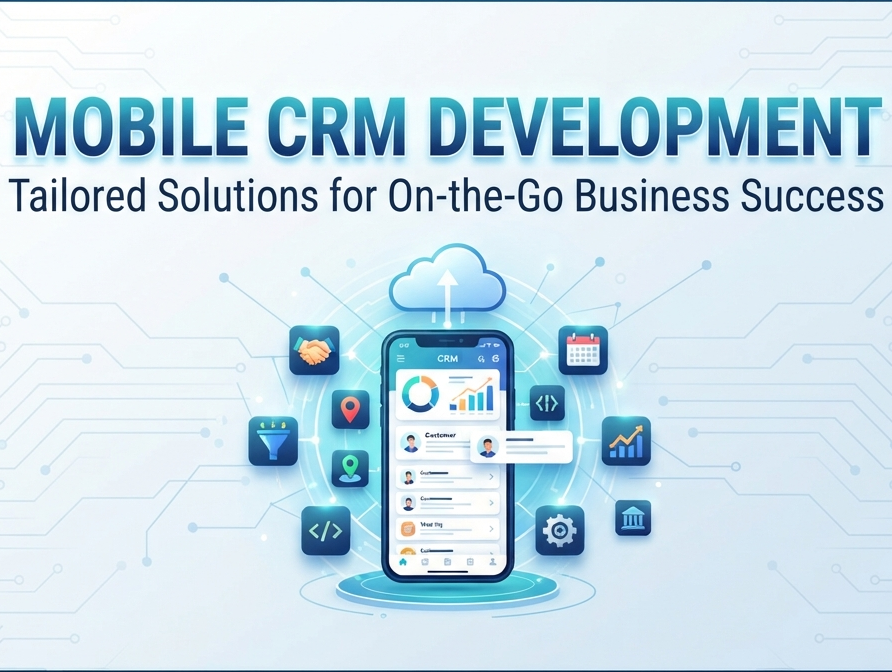
Corewave has the expertise to build mobile CRM apps that let users perform CRM functions on the go. Mobile employees such as sales personnel and service personnel often need to access CRM functions outside their work desks. A mobile CRM app can be designed to provide access to customer information, leads, opportunities, tasks and reminders, and other elements. The app can also provide notifications. Corewave can utilize the Flutter Framework to build mobile CRM apps. However, the mobile app should not be an exact replica of the desktop app. The app should be designed based on the activities that are most occurring on the mobile app. The app should also focus on readability and ease of data entry.

CRM Analytics and Dashboard Development

Corewave can also create customized CRM dashboards to suit the business requirements of various employees. For example, a dashboard for a sales representative can provide lead and opportunity information along with follow up tasks. A sales management dashboard can provide information about the sales pipeline and the activities of the sales representatives. An administrative dashboard can provide more broad and integrated information about the overall business.

CRM analytics can cover:

  • Lead volume and sources
  • Conversion rates
  • Sales pipeline
  • Opportunity values
  • Follow-up activities
  • Sales performance
  • Customer activity
  • Support requests
  • Ticket status
  • Response times
  • Team productivity
  • Customer engagement

The dashboard structure can be customized according to the metrics that matter to your business.

CRM Security and Data Protection

CRM applications can contain and consolidate various types of information about customers, sales, employees, and the overall business. Corewave can implement various types of controls during the development and implementation of the CRM application to protect the overall business and application information.

Stakeholders at different levels in the organization have different access permissions to the CRM. For example, sales personnel can view their assigned customer records, while a manager can view reports of the sales team, and an administrator can set user permissions and customize the CRM. The security of a CRM solution is determined by a number of factors including the nature of the business, the region, types of data, legal requirements and policies of the organization.

CRM Development Process at Corewave

A successful CRM requires more than development. It requires a clear understanding of the business process before technical implementation begins.

1

Requirement Discovery: We begin by understanding your business model, users, workflows, customer journey, pain points, integrations, reporting requirements, and future objectives.

2

Business and Workflow Analysis: The team maps how leads, customers, tasks, communication, approvals, sales activities, and support requests move through the organization.

3

CRM Architecture: We define the technical architecture, database structure, APIs, authentication, permissions, integrations, cloud environment, scalability requirements, and development roadmap.

4

UI/UX Design: Interfaces are designed around user roles and daily workflows, with attention to navigation, dashboards, forms, search, filters, data presentation, and responsive experiences.

5

Development: Frontend, backend, database, APIs, integrations, dashboards, automation, authentication, and other approved modules are developed according to the project scope.

6

Testing: The CRM is tested for functionality, usability, responsiveness, APIs, integrations, authentication, authorization, performance, and other applicable requirements.

7

Deployment: After testing and approval, the CRM is deployed to the selected hosting or cloud environment with the required configuration and monitoring.

8

Support and Enhancement: Post-launch development can include maintenance, performance optimization, security updates, new features, integrations, automation, and future scalability improvements.

Technology Stack for CRM Development

Corewave selects technologies according to the CRM's functionality, expected scale, integrations, performance requirements, security considerations, and long-term maintainability.

Technology Area Technologies / Approach
Frontend DevelopmentReact.js, HTML5, CSS3, JavaScript
Backend DevelopmentNode.js, Python
Mobile DevelopmentFlutter
DatabasePostgreSQL and suitable database technologies
API DevelopmentREST APIs, Webhooks
AuthenticationSecure Authentication, Role-Based Access
Cloud InfrastructureAWS, Microsoft Azure
AI IntegrationAI APIs, LLM-Based Features, ML Workflows
NotificationsEmail, SMS, Push Notifications
TestingFunctional, API, Integration, Performance Testing
DevOpsCI/CD, Deployment, Monitoring
SecurityAuthentication, Authorization, API Security, Data Protection
AnalyticsCustom Dashboards, Reports, Business Insights

The technology stack is not necessarily identical for every project. Corewave evaluates the CRM's functional requirements, expected user base, integrations, performance requirements, budget, and future roadmap before finalizing the architecture.

CRM Development Cost in Mumbai

The cost of a CRM development in Mumbai is determined by the number of features and their complexity. A CRM solution with a moderate number of features can cost over the features such as automated workflows and rules, integrations, mobile apps, artificial intelligence, advanced security, and data migrations increase the price and complexity of the solution.

CRM Type Approximate Development Cost Estimated Timeline
Basic CRM₹2.5–7.5 Lakh8–14 weeks
Mid-Level CRM₹7.5–20 Lakh14–23 weeks
Advanced CRM₹20–45 Lakh23–40 weeks
Enterprise CRM₹45 Lakh+40+ weeks

The prices provided are estimates and depend on the number of users, features, and how the CRM solution is integrated with other solutions. The prices are also dependent on the technology and infrastructure the solution is built upon, how is UI/UX, mobile apps, artificial intelligence, data migrations, and how the CRM solution is deployed. Corewave can provide an approximate cost of features based on the functionality the CRM solution needs to implement.

CRM MVP Development for Startups and Growing Businesses

You don't always need to implement an enterprise CRM out of the box. Some start-ups and small businesses can implement a more feature-limited CRM to begin with and extend the CRM based on requirements. Initially a CRM can help manage leads, customers and sales, provide task reminders and follow-ups, and assist in user and customer record management, and offer basic reporting, dashboards, and notifications. Further a core set of features can help validate a CRM system. Based on the requirements of the business and the usage of the CRM, various features such as integrations, automation, customer support, document management, analytics, mobile apps, AI, and more can be added. An MVP based approach can help in validating the features and workflows of a CRM.

Why Choose Corewave as Your CRM Development Company in Mumbai?

Choosing a CRM development company in Mumbai involves more than comparing development technologies. The development partner needs to understand business processes, customer journeys, software architecture, integrations, security, usability, and long-term product requirements. Corewave brings 7+ years of expertise in software development, with 100+ projects delivered across 20+ industries and 100% client satisfaction. Our experience supports a development approach focused on practical business requirements rather than unnecessary functionality.

7+

Years of Expertise: Corewave brings more than seven years of software development experience across different business and technology requirements.

100+

Projects: With more than 100 completed projects, Corewave has worked on different types of digital products and software development requirements.

20+

Industries: Experience across 20+ industries provides exposure to different workflows, customer journeys, operational processes, and technology requirements.

100%

Client Satisfaction: Corewave's stated client satisfaction is 100%, reflecting the company's focus on delivering projects around client requirements and expectations.

•

Business-Focused Development: We focus on understanding the business problem before defining the technical implementation, helping ensure that CRM functionality has a practical purpose.

•

Scalable Technology: CRM architecture can be designed to accommodate additional users, modules, integrations, automation, and functionality as business requirements evolve.

Why Businesses in Mumbai Choose Custom CRM Development

Mumbai has numerous businesses of all sizes that have digitized their customer management processes. Often, when a business in Mumbai finds the need to go beyond a simple contact management system, there is a requirement to automate business processes such as sales, after-sales support, reporting, and other business processes. Corewave is CRM development company in Mumbai that offers CRM development services to automate business processes and customer management. Our development model can support local organizations as well as businesses working remotely across India and international markets.

Build a CRM That Fits Your Business With Corewave

With 100+ successful implementations, including CRM development and related services in AI, Automation, Integration, Analytics, Mobility and other surrounding Technology, Corewave maintains of 100% Client Satisfaction and operates out of its state-of-the-art development centers in India. As a CRM development company in Mumbai, we provide start to finish CRM software development to clients of all sizes. We take pride in our ability to understand our client's business. With 7+ years of experience and 100+ successful implementations, we provide scalable CRM solutions to clients across multiple industries. Our clients benefit from our stress free, feature complete and fully integrated CRM solutions.

Contact us for a free consultation and quote on your next CRM project.

Let's Work Together

Need a CRM That Fits Your Business?

Get Free Consultation
Faq

Frequently Asked Questions About CRM Development in Mumbai

A CRM development company in Mumbai creates custom CRM solutions based on a business's processes, the way customers interact with their business, the roles customers and employees interact with the system, the way management reports are generated, integrations, process automation, and technology.

CRM development costs in Mumbai can range from 2.5 lakh INR to 45 lakh INR or more. Costs are determined by the number of systems the client wants developed and the features, integrations, and automations the systems have. Mobile application development, the use of Artificial Intelligence (AI) and other advanced features, and security and infrastructure of the system also affect costs.

Straightforward CRM development can take about 12 to 20 weeks. More complex CRM systems can take longer.

Yes, Corewave builds custom CRM software for businesses of all sizes.

In addition to custom CRM software development, Corewave offers CRM application development, integrations, process automation, development of artificial intelligence (AI) and other advanced features, dashboards, migration of data, testing, deploying software and providing software support.

Yes, Corewave can develop CRM software that uses AI for functions like intelligent searching, automatically creating summaries of emails, and classifying leads among other things. AI also can be used for customer support and other functions.

Yes, many integration methods including REST APIs and webhooks are supported. Integration with various internal and external applications and services is permitted.

Yes. Mobile CRM applications with components like contact/lead management, tasks and follow ups, and management notifications, dashboards, and searches is within the scope of our work.

Yes, Corewave develops custom APIs and webhooks to facilitate integration with supported services and applications for data synchronization and employment of appropriate security protocols.

Yes, migration involves extraction of CRM data, and loading the data to the new CRM, ensuring data integrity and validity. Transformation and mapping of data to new format is also done if required.

If a business has distinctive and unique processes and procedures that are not covered by existing business systems, a custom CRM system will be appropriate. An MVP will help limit the scope of work in the custom CRM system.

For development of CRM systems, Corewave can use any of the following technologies: React.js, Node.js and Python; databases: PostgreSQL; mobile applications: Flutter; web and API services: REST, webhooks; cloud services: AWS and Azure; and AI services.

Yes, a CRM system can define and automate several actions related to follow-ups including task creation and notification.

Yes, Corewave can design dashboards and reports based on the requirements of individual users.

Corewave offers 7+ years of expertise, 100+ projects, experience across 20+ industries, and 100% client satisfaction, along with custom CRM development, integrations, automation, AI functionality, mobile development, analytics, and scalable technology solutions.

Contact Information

C - 273, Sector 63, Noida, Uttar Pradesh 201301

We're Available 24/7. Call Now. +91 98106 76072 +91 99997 30515 corporate@corewave.io
Find us here