First Timer’s Guide to Agile Mobile Development: Exploring the different phases of mobile app development
Learn moreSwipe to Check More
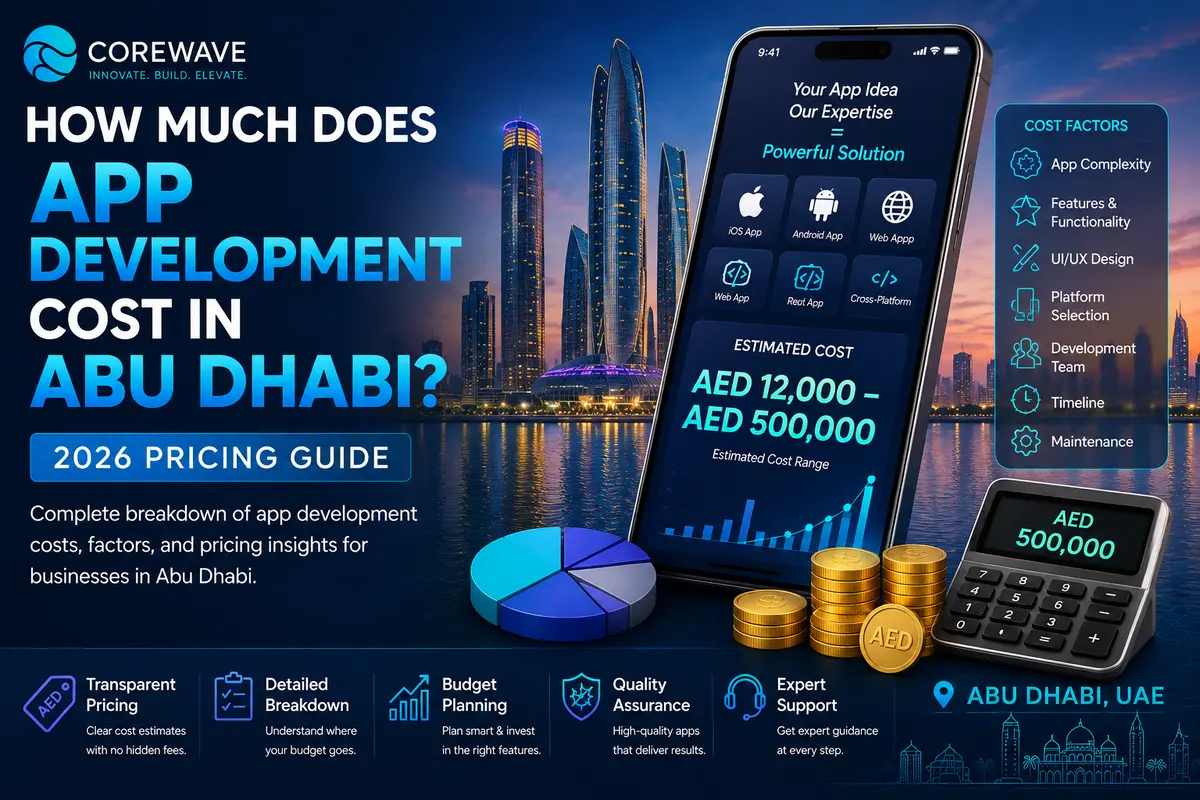

Are you planning to create an app for mobile devices within Abu Dhabi and wondering what it will cost you? Youre not alone. Its one of the first questions that every business owner, SME owner, or enterprise decision-maker has -- and is one of the toughest to get a clear answer to, as "it depends" is technically true, but not very practical.
The quick answer is: Mobile app development costs in Abu Dhabi typically ranges from AED 12,000 to 25, 000 for a simple application, AED 50,000 to AED 150,000 for an intermediate-complexity business application and AED 150,000 - AED 500,000+ for an enterprise-grade or feature-rich platform. The final price is contingent on the amount of screens, the complexity of the backend integrations, as well as the compliance requirements.
At Corewave we have developed and shipped apps in logistics, retail fintech, healthcare, and logistics for clients throughout the UAE So this guide is based on actual project costs not just a guesswork. When youre done reading this article, youll be aware of the exact factors that determine your apps cost and what a typical price includes, and what agencies omit.
The digital economy in Abu Dhabi has grown rapidly under programs such as Smart Abu Dhabi and Ghadan 21 and that expansion is evident directly in the demand for app development. Fintech, government-adjacent services healthcare, logistics, and businesses across the emirate all being pressured to become digital and this has resulted in the pull agencies that range from small local studios to big regional players. That is the reason for the price range you see online is so vast. This guide will help reduce that range to an amount you could make a budget for.
Its also worth stating upfront that the cheapest quote and the most value are not the same thing. A quote that is priced low typically means one of three things: an inexperienced team learning about your project, a scope that will slowly increase as development progresses or cutting corners on security and testing. None of them will can save you money in the long in the long run. The purpose of this article is to let you know what youre paying for, so that you can compare quotes based on substance instead of just the headline price.
| Tier | AED range | USD equivalent | A typical timeline | Best for |
|---|---|---|---|---|
| Basic / MVP | AED 12,000 - 25,000 | $3,300 - $6,800 | 4-8 weeks | Test an idea, one key feature |
| Mid-tier Business App | AED 50,000 - 150,000 | $13,600 - $40,800 | 10-16 weeks | Most SMEs, e-commerce, service apps |
| Platform for enterprise / complex | AED 150,000 - 500,000+ | $40,800 - $136,000+ | 20-30+ weeks | Fintech, healthcare, multi-tenant platforms |
This table alone addresses the main question But the real planning is when you understand the reasons behind why two programs that appear similar on paper could end up in totally different places.
The market for apps in the UAE has been growing rapidly. The percentage of smartphone users in the country is close to 99% and both businesses and consumers are now demanding polished, fast and multilingual (English/Arabic) experience - which raises expectations for quality and, consequently, costs, higher than in other countries.
For 2026, heres an additional description of what you will pay for each stage of an apps development in Abu Dhabi:
| Stage of development | Part of the budget | What is it that it includes |
|---|---|---|
| Discovery & scoping | 10-15% | Gathering requirements, user flows and technical planning |
| UI/UX design | 15-20% | Wireframes, high-fidelity screens prototyping |
| Development (iOS/Android) | 45-55% | Frontend, backend, API integration |
| Testing and QA | 10-15% | Functional testing, performance, as well as security testing |
| Deployment & launch | 5-10% | App store production setup, submission |
A well-planned AED 80,000 project could, for instance, spend around AED 10,000 on discovery, 14,000 AED for design, AED 40,000 for development, and AED 10,000 for Quality Assurance, and AED 6,000 for the launch. Agencies who skip discovery and design in order to "save money" almost always cost their clients more in the future due to unclear requirements that cause them to the need to change their plans mid-build.
Two apps could look almost identical to a users mind and yet be AED 100,000 different in price. Heres what is actually changing the amount.
Each screen needs design development, testing, and development time. A simple 10-screen app with basic navigation costs a small fraction of the price of a fifty-screen app with personalized flows, nested flows and multiple roles for users. As a general guideline, every screen costs AED 1,500 to 3,000, depending on the how complex.
A simple application that is that is powered by Firebase or a similar backend-as a-service can be developed quickly and cost-effectively. A custom backend built with Node.js, PostgreSQL, or similar stacks -- is more expensive upfront, but it will scale much better when youve got real users, handles complicated business requirements, and offers complete control over the data architecture.
Live order tracking, chat in-app and real-time notifications need WebSocket infrastructure, as well as backend engineering. These functions typically add AED between 5,000 and 15,000 to a project, based on how thoroughly they integrate into the overall experience.
Every business app that is available in the UAE eventually requires payments. Integration of Stripe, Apple Pay, or an local UAE payment gateway safelywith the proper PCI compliance -- usually will cost between 3,000 and 8,000 AED, based on the number of payment options you accept.
Building for one platform is generally less expensive than building for both. A lot of Abu Dhabi startups choose a cross-platform platform like Flutter or React Native specifically to launch on iOS and Android simultaneously without increasing the cost of development generally adding 20-30% to a single-platform build, instead of 90-100 percent.
A template-based user interface with minimal customization costs much less than a fully customized animated design system. If your brands identity is a key element of the user experience of your product -- think of consumer-facing hospitality or retail appsexpect design to consume an increased share of your budget.
Integrations with CRM, ERP connections, government ID verification (UAE Pass) and Arabic layout support are all common across the region. Each adds development and scoping time. UAE Pass integration for instance, is common in government-adjacent fintech applications and usually adds a few thousands AED for dedicated engineering time.
Local Abu Dhabi and UAE-based teams generally cost higher hourly rates than offshore teams, however that cost usually means that you get overlapping work hours, a simpler compliance with local requirements regarding data residency and a team who already knows the UAE-specific requirements, such as VAT-invoices as well as Arabic localization standards. Offshore teams are often significantly less expensive, but you must take into account the cost of communication overhead as well as slower iteration times when looking at quotes side-by-side and comparing hourly rates. A lower hourly cost does not necessarily translate into an overall lower cost when timeline slippage is considered for.
Revisions to design and development are often the least understood portion of a quotation. A quote that contains two rounds of design revisions is almost always less expensive as opposed to one that claims "unlimited revisions" with vague limits, since the unlimited scope of paper can tend to result in extended time frames and renegotiated costs after the project is in progress. Ask any agency youre considering how many revisions are included in their quote prior to you make comparisons.
Before you compare different app types it is worthwhile to consider a question that nearly every founder has to ask at some moment whether to hire an in-house team or work with an independent contractor or use an agency? Each choice has a different cost structure not just a distinct cost.
| Option | Cost profile typical | Best for | Main risk |
|---|---|---|---|
| In-house team | The most expensive upfront (salaries tools, benefits, and salaries) with the lowest long-term cost per feature | Companies developing a long-term solution that is continuously improved | It is slow to hire, and it is difficult to fill vacancies during peak periods. |
| Freelancer | The lowest hourly rate, however high-variable total cost | Very small, narrowly conceived projects that are very small, with a limited scope. | A lack of accountability structure, one point of failure in QA, inconsistent |
| Agency (like Corewave) | Mid-to-high in the beginning but fixed-scope and predictable | The majority of SMEs and startups are working on an initial or second product | The wrong agency choice could still lead to scope creep |
For an application that is well-defined and single An agency almost always offers the highest cost-to-profit ratio. Youre not paying for a single persons time; you are paying for an entire design process and a development process as well as a QA procedure and an experienced team that has dealt with the majority of issues the project will encounter. In-house teams can be beneficial when you are shipping on a continuous basis across multiple products. Freelancers work well for very small, tightly-defined additions to an existing product.
For making these figures less abstract, think of two founders who joined Corewave with the same basic concept: a service-booking application specifically for the Abu Dhabi market. One had a narrowly defined MVP that consisted of a single booking flow with basic profiles and one payment method and a budget of around AED 45,000. The other required a fully-featured platform from day one with multi-vendor support, live tracking, chat in-app and three payment options with a budget of AED 220,000.
The founder who launched the first project within seven weeks, and began receiving feedback from real users within one month, and utilized early profits to fund the next round of features. The second venture took 5 months to launch, and needed two rounds of scope adjustments during the process, due to certain features that seemed simple at the time of a kickoff ended up requiring extensive backend work after the development process began.
The two approaches are not "wrong" - a fintech platform is definitely going to require more upfront capital than an app for booking. But the lesson is applicable regardless of the budget: the more compact and clear your first scope of work, the more precise the final cost you will incur.
Costs differ significantly according to category, as the different types of apps have different features. Heres a comprehensive breakdown of the most popular category of apps in Abu Dhabi:
| App type | AED ranges that are typical | What is the reason for the cost? |
|---|---|---|
| Basic app for booking and utility | AED 15,000 - 40,000 | Simple bookings basic user accounts the bare minimum of backend |
| E-commerce app | AED 50,000 - 150,000 | Cart, catalog payment and order tracking |
| On-demand/delivery app | AED 80,000 - 200,000 | Real-time tracking driver app dispatch logic |
| Fintech app | AED 150,000 - 400,000+ | Compliance with regulations, KYC, secure transactions |
| Healthcare app | AED 120,000 - 350,000+ | Data privacy compliance Integrating appointment systems, data privacy compliance |
| Enterprise/multi-tenant SaaS | AED 200,000 - 500,000+ | Custom architecture, admin dashboards, scalability |
If your app falls into different categories, for instance an e-commerce application that includes on-demand delivery anticipate your costs to be at the upper part of both ranges, rather than simply adding them up.
The number on your development proposal isnt always the amount you actually spend during the first year of your app. The following are costs that will catch the majority of founders who are first-time entrepreneurs off guard.
| Hidden cost | A typical amount | Frequency |
|---|---|---|
| Apple Developer Program | $99 (~AED 365) | Annual |
| Google Play Developer account | $25 (~AED 92) | One-time |
| Cloud hosting (AWS/Azure) | AED 500 - 5,000/month | Monthly, scales according to the usage |
| Post-launch maintenance | 15-25% of the cost for construction | Annual |
| Audits of security and compliance | Variable, more expensive for fintech/healthcare | Periodic |
| Arabic RTL Redesign (if not planned upfront) | AED 5,000 - 15,000 | One-time |
Maintenance is the the most budget-conscious people dont plan for. A application that costs AED 100,000 and isnt maintained will begin showing problems within a few months due to iOS and Android push OS updates. Budgeting 15 to 25% of the construction costs annually for maintenance isnt a luxury Its the norm.
In short, broadly similar in that Abu Dhabi trending slightly lower on average for similar range. Dubais market is bigger and more crowded with numerous agencies competing on a broad price range, which means Dubai pricing can fluctuate significantly less (via offshore studios that are heavy on the money) and significantly more (via premium agencies that serve startups with good funding) in comparison to what you normally see at Abu Dhabi. For most SME-level projects the difference in the actual cost between Abu Dhabi and Dubai is from the specific companys structure, team composition and expertise, rather than to the actual city.
What is more important than a citys location is the person who is creating the code, if they have previously delivered similar applications that are UAE-compliant before and how transparent their description of whats included.
Every Corewave project is governed by the same standard procedure regardless of budget level:
This structure is intentional The projects that go over budget are often those that didnt make the decision in order to "move fast."
Not every low price is a bad deal and not every high price is a good deal. There are a few patterns worth keeping an eye on regardless of the agency you contact:
None of these warnings mean that you must you should leave immediately. they are simply a direct follow-up inquiry before you make a payment.
Every business is unique and the ranges listed included in this article are just what they sound like -they are limits. The only way to determine your exact number is an estimate that is scoped that is based on your particular features such as integrations, timelines, and other features. Corewave offers fixed-scope quotes that include transparent AED pricing with without hidden line items. Contact us for a no-cost consultation and well be back with a full explanation within just 48 hours.
The majority of apps that are available in Abu Dhabi cost between AED 12,000 for an entry-level MVP and AED 500,000or more for a more complex enterprise-grade platform. The majority of SME business apps cost between AED 50k to AED 150,000.
The most important aspects are the number of options and screens available, the backend complexity, real-time functionality payment integrations, platforms (iOS, Android, or both) and any UAE-specific compliance requirements or Arab RTL regulations.
Pricing is generally comparable for both cities and Abu Dhabi is the exception, but with Abu Dhabi trending slightly lower in average. The experience of the agencys team and structure usually affect the final price than the city theyre based in.
A basic MVP usually takes between 4 and 8 weeks. A mid-complexity business application can take 10 to 16 weeks, while Enterprise-grade applications can be 20-30 weeks or more depending on the scope.
A good quote should outline the discovery and scoping process design and UI/UX development, QA and testing and finally, the deployment. Be wary of quotes that offer one lump-sum development cost without a stage breakdownwhich is often where hidden costs sneak in later.
Firebase and similar backend as-a-service platforms are ideal for basic apps and quick MVPs. If your app is complex in its business logic, requires grow to a larger number of users or has unique requirements for data architecture an bespoke backend is typically the best long-term investment.
If your budget can only support one platform initially, take a look at where your intended users are actually located -- iOS is a leading platform for consumer-oriented applications in the UAE however, Android is often more popular for utility or mass-market apps. Making both platforms at the same time using an open-platform framework such as Flutter is generally more cost-effective than launching a single platform today and then porting it later, as porting successfully requires rebuilding a significant portion of the app again.
Plan for 15 to 25% of the cost of your initial build annually to cover maintenance, including OS compatibility updates bugs security patches, as well as minor enhancements to features. Applications that are not maintained tend to develop problems that are visible within the period of three to six months when Apple and Google release the latest OS versions that werent part of the initial testing process.