First Timer’s Guide to Agile Mobile Development: Exploring the different phases of mobile app development
Learn moreSwipe to Check More

Have you ever thought of an idea for a great app only to be stuck by the most gruelling technology-related question: "How much is this likely to cost?
If youve looked on the internet, youve probably seen prices that range between "$5,000" up to "half one million dollars." Its difficult to understand, and honestly, its not very helpful. In 2026 the mobile application landscape has changed. With the advent of AI-augmented development as well as smarter cross-platform frameworks we estimate costs has been forever changed.
Corewave is a company that believes in transparency. We at Corewave believe in transparency as the foundation of innovation. You dont require a vague estimate; you require an outline. In this article, were taking a look at the costs of developing apps for you to make data-driven decisions that will protect your budget and help drive growth.
Before we dig into the figures, lets get it crystal clear: the price of an app is directly related to its level of complexity. Imagine building a home. A small cabin in the woods is much less than a high-end smart home equipped with a customized security system.
When you reach out to an engineering team the "complexity" of your application determines the number of hours of design, engineering and testing are required for the project.
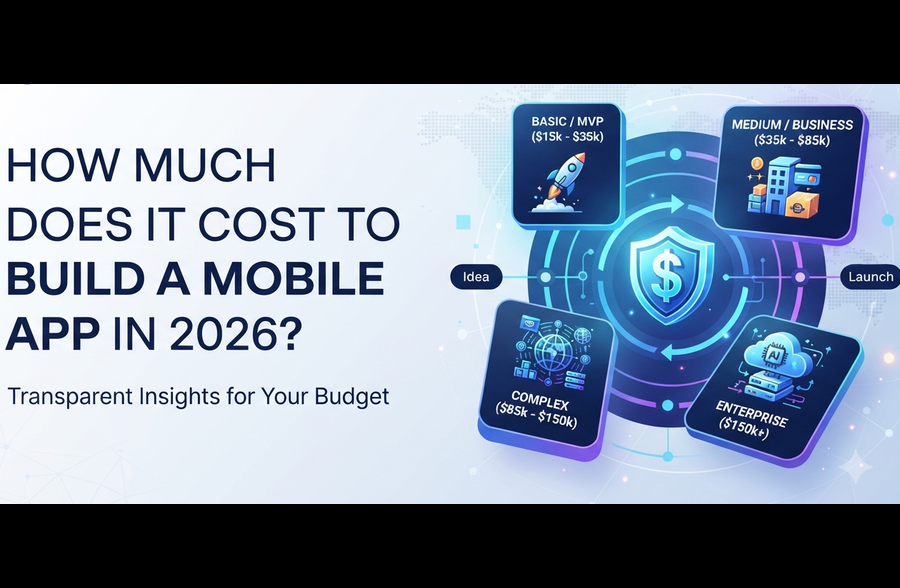
Its the "Minimum Viable Product" stage. The goal is to bring your concept into the hands of real users as fast as you can. The majority of these apps use the standard UI templates, easy user logins, and a central dashboard. They are great for experimenting with the market without draining your savings account.
If your app has to go beyond "show" data, like processing payments and connecting to third-party APIs, or providing user profiles that are personalized, youre in the middle level. This usually involves a custom UX/UI designs that match your brands image and the integration of AI features that are basic like basic chatbots for customer support.
The big leagues are here. The apps were designed to address the most complex of problems. Think of real-time GPS tracking streaming video in high-definition, or apps that must support multiple languages as well as complicated backend syncs. At this point performance and reliability are not negotiable.
If youre building for the masses Youre creating for security and scale. These applications require customized Machine Learning (ML) models as well as military-grade security infrastructure capable of handling millions of users at once. Its a substantial investment however, its designed to be a leading market asset.
Knowing the cost of a program can be like trying to navigate a maze. Although the complexity of your application is the most important element, a variety of decisions regarding the design and technology impact the amount you spend. In 2026, the development process will no longer be solely about writing code; its about creating an AI-ready, scalable architecture.
The most crucial choices youll take is to choose the framework for your development.
The level of experience of your teams developers is a major cost factor. Working with a reputable mobile App Development firm will ensure that youre not paying for code lines and coding, but also for design as well as risk control. An experienced company brings already-built modules and frameworks that have been tested on the scene, that significantly reduces risk of "rework" risks and can save your money over the long term.
in 2026 AI will be a common and not the status of a luxury. However, the degree of this integration will be an important cost driver.
Your brands design is your online storefront. Although templates are inexpensive but they arent able to differentiate your business from a crowd market. A customized highly interactive UX/UI design is a complex process that involves extensive wireframing, user journey mapping and prototyping iteratively. Although this can increase the initial cost, its an essential factor in retention of users, which dramatically influences your long-term ROI.
When it comes down to creating top-quality software without spending a lot of money the "where" is as crucial as the "how." For many companies around the world, India has become the top source of technical talent. But why is it that India regularly outperform other countries when it comes to the return on investment (ROI)?
The cost difference is substantial. Although developers from North America or Western Europe typically pay between $90 and $250 an hour, India offers world-class talent at a fraction of the cost. Typically, the rates range between $15 and $90 an hour. When you select a reliable mobile App Development company that is based in India You arent only saving money, youre effectively expanding your budget to allow for more features, a better design and a longer-term maintenance cycle.
India isnt just a savings destination, but its also an international hub for technological innovation. With the highest number of STEM graduates in the world, India has grown into a thriving hub for specialized technologies such as AI machine learning, AI, and cross-platform frameworks like Flutter as well as React Native. If you work with an established Indian agency, you get access to experts who arent just technically proficient, but also accustomed to working on a variety of high-risk global projects.
One of the most common misconceptions regarding outsourcing is that it creates that of the "time zone issue." In actuality the most modern Agile workflows have been designed to transform this into a competitive advantage. Many Indian companies use multiple schedules that allow for real-time collaboration. This "follow-the-sun" method means that your project can run smoothly all day long. Development takes place while you sleep and you awake to new updates completed tasks, as well as ready-to-review designs.
The majority of project budgets fail not due to the initial development costs instead, they fail because the projects stakeholders do not consider the longer-term "Total cost of Ownership" (TCO). The process of building an app is similar to purchasing a car. The purchase price is only the beginning. To ensure that your app is functioning smoothly, secure and competitive by 2026, it is essential to prepare for the ongoing investment.
Technology moves fast. Each every time Apple or Google launches an updated OS version of their software, the application must be re-updated to stay compatible. Furthermore, as threats to cybersecurity change, youll need to regularly conduct security checks and patches. You should allocate between 15%-20 percent of your initial development expenses annually to cover these important maintenance tasks and to ensure that your platform is stable.
Your app is hosted on the server. As the number of users you have increases the infrastructure costs - including storage and hosting for databases, and bandwidth will increase accordingly. No matter if youre using AWS, Google Cloud, or Azure or Azure, these are all regular monthly operating expenses to be accounted for in your businesss long-term plan of operation.
Do not forget the "toll" to conduct business. Both Apple App Store and Google Play Store charge annual fees for developers accounts. Additionally, they earn an amount of commissions on purchases made in-app or paid apps downloaded. Knowing these policies for your platform early can prevent any unexpected impact on the margins on your revenues.
The creation of a top-quality application is only half of the fight. If your intended audience cant access your application, your investment will be gone. A success in the year 2026 needs an allocated budget in order to ensure App Store Optimization (ASO) as well as digital advertising and content marketing to increase downloads and keep users interested.
Corewave is a company that believes in transparency. Corewave we consider transparency to be the most important competitive advantage. We dont just code; we collaborate with you in the creation of an environmentally sustainable digital asset while ensuring that you meet the goals of your finances. Our strategy is designed to reduce any waste and maximize the worth of each dollar that you invest into your project.
We assist you in identifying those "must-have" attributes that will provide immediately value to your customers. When you launch a simplified MVP to validate your products value in the marketplace with lower initial costs, while avoiding the typical error of building too many features that users might not need.
Through the integration of advanced AI-code assistants with automated testing tools our engineering teams have reduced the amount of boilerplate code and development time by 20-30 percent. This efficiency lets us create high-quality, bug-free software quicker, and then pass the savings directly onto our customers.
Security is our top priority right from the first line of code. Through the implementation of robust protocols, like ISO-compliant standards, you can avoid costly security flaws and system failures prior to they occur which can save you substantial costs in the future, both for maintenance and repair.
Development costs include more than the coding itself; they also include UX/UI design, strict QA testing as well as project management and logistics for deployment and all of these contribute to the final cost.
Frameworks that cross-platform like Flutter and React Native allow developers to make use of a single codebase that works for iOS and Android as well, which could cut the cost of development by between 30 and 40 percent.
The length of time varies based on the level of their complexity, ranging from a few months for MVPs to 9-12+ months for enterprise-grade applications.
The most frequent error is not accounting for total Cost of Ownership (TCO) which includes regular service, maintenance costs and marketing, all of which are vital to long-term growth.
Yes, we are committed to developing long-term relationships with our customers and provide continuous support to ensure that your application is always up-to-date efficient, secure, and reliable.