First Timer’s Guide to Agile Mobile Development: Exploring the different phases of mobile app development
Learn moreSwipe to Check More
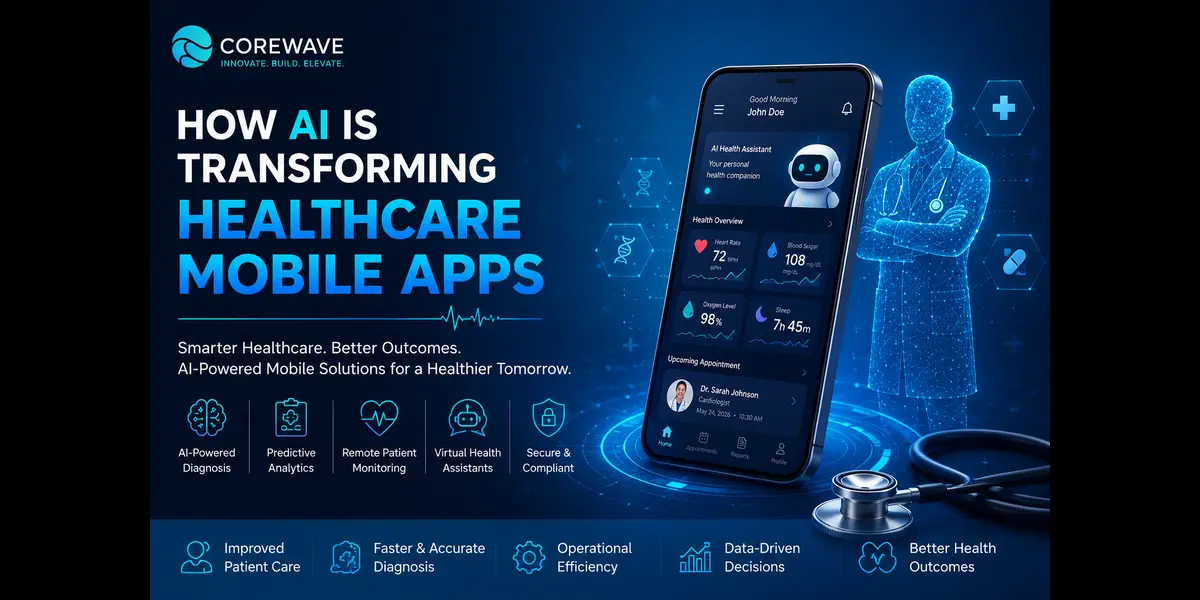

Artificial intelligence is revolutionizing the way applications function for the better. It has changed the way medical institutions and ventures function and address patient needs. More and more organizations are focusing on integrating AI in healthcare mobile apps. We live in the digital age, so it is easy to find an AI app development company in case you lack the expertise yourself or are intimidated by the upfront costs of hiring an in-house team.
Choosing to integrate AI in healthcare can bring about a massive change in fortunes for any venture in the industry. Working with a good custom software development company is a great way to get better AI services that are tailored to your needs. It brings many other advantages as well.
Working with a mobile app development company is a great way to obtain solutions like AI chatbots and Voice Assistants for your healthcare venture. These tools are capable of interpreting medical queries and other general questions to provide suitable answers. You can also build virtual assistants that perform tasks like scheduling appointments, medication reminders, providing immediate responses, etc. By automating these tasks, human effort can be allocated to more critical operations.
Artificial intelligence can comprehend and derive insights from many different types of data, including medical imaging (eg., X-rays). They also go through patient history and genetic details to understand patterns and insights quickly and more effectively compared to humans. Hence, AI in healthcare mobile apps can quickly list out potential health problems the patient is at risk of developing so steps can be taken to resolve the issue promptly.
One of the major positives has been the emergence of AI in healthcare mobile apps to address mental health issues. You get relaxation techniques, CBT exercises, mood trackers, etc., that are of immense benefit to patients with anxiety and depression. Many of these features can be accessed anytime and anywhere, which further adds to their popularity.
Introducing AI healthcare app development has enabled doctors to use its insights to provide better treatment to each patient, taking their unique needs into account. AI considers medical history and other relevant reports so that recommendations and guidance can be tailored more effectively. Working with a good healthcare app development company can ensure that all of these bases are covered.
You can find many smart healthcare apps that help you manage conditions like asthma, heart disease, diabetes, etc. AI is capable of helping you measure your vital signs, check your medicine intake patterns, provide personalized recommendations, etc. Wearable devices can also be used for AI patient monitoring.
Integrating machine learning development services into building apps for your healthcare venture enables you to offer better solutions. By combining human effort and artificial intelligence, we can provide more effective solutions.
Most medical professionals now have to make bigger decisions in a shorter amount of time. They have to evaluate more data and go through tighter regulations. Using AI in healthcare mobile apps can reduce the odds of medical errors and offer better patient outcomes. By giving you useful insights in real-time and integrating seamlessly with existing workflows, it improves outputs massively.
Administrative issues can also have an impact on the overall patient experience and sometimes even outcomes. Adding AI Medical Apps to administration procedures can minimize confusion and make it easier for patients to get treatment. Bed assignments, discharge formalities, coordination between departments, etc., can all be improved massively.
Maintaining electronic health records can be time-consuming and take attention away from other areas that matter more. By automating this process through AI healthcare software development, doctors can focus more on actual treatment. Manual documentation also comes with a higher possibility of human errors. It works in real-time and provides smooth integration with EHRs.
Accurate coding is important in the medical industry and prevents slow workflows and errors. AI healthcare automation makes these processes easier, saving time and effort. Human coders often miss key nuances that lead to underbilling. You also avoid issues with delayed turnaround times. AI reduces claim errors and is adaptable to billing guidelines, too.
You can virtually test a treatment plan to see how a patient is likely to respond to certain forms of treatment. A digital twin is a dynamic and data-driven simulation that aims to predict how a patient is likely to respond. This AI healthcare software provides more personalized care, is comparatively less risky, more affordable, etc.
The influence of AI in healthcare mobile apps is only expected to grow as time progresses. However, many critics feel it is a threat to jobs in the medical field, but experts feel differently. The main purpose of artificial intelligence is to boost productivity while holding on to existing staff and providing better patient outcomes.
One must also note that AI is still growing and has not yet been perfected by the masses. Certain aspects like privacy and data security are still in progress. Algorithmic biases can cause problems from time to time, while unequal access and affordability result in small businesses falling behind in this regard.
Taking more initiatives to promote AI in healthcare mobile apps is important as it can improve healthcare processes and make life easier for patients. It provides automation that can speed up workflows and improve productivity. Corewave understands these needs and knows how to build the right solutions to elevate your healthcare venture.
It refers to the use of artificial intelligence in the medical industry to improve administration, patient outcomes, operational efficiency, etc.
Artificial intelligence allows for better diagnosis, personalized treatment plans, automation of workflows, better analysis to obtain insights, etc.
AI saves time, mitigates risks, reduces human effort, improves productivity, leads to better patient outcomes, etc. Its positive influence continues to grow over time.
The exact cost will vary from country to country and also based on the scope and dimensions of the project. It is difficult to give a one-size-fits-all figure.
Some features you should always include in your healthcare app are smart scheduling and booking, predictive risk assessment tools like digital twins, remote medical assistance, personalized medical advice, etc.
Yes. AI automates several key tasks, saving manual effort and allowing medical professionals to focus on improving patients’ health. It also helps with medical imaging and can detect anomalies that humans are often unable to pick up.
AI is expected to continue growing as the years go by. Despite common fears of it replacing human jobs, experts feel it will only improve productivity, and the job market should not be affected too severely by it.
They are very secure but not perfect, and work is still being done to improve in this regard.
The exact timeline varies based on the scope of the app and its complexity. A simple MVP may take around 10-14 weeks, while a very advanced project can take up to a year or more.
Artificial intelligence tools like Generative AI, predictive modeling, NLP, computer vision, RPA, etc., are growing in popularity within medical settings.